
The Relevance of the Bhagavad Gita in the Indian Legal System

This article is authored by Rajeshwari Gupta, a third-year law student at Law Centre-I, Faculty of Law, University of Delhi, and a Campus Ambassador at Lexful Legal
Introduction
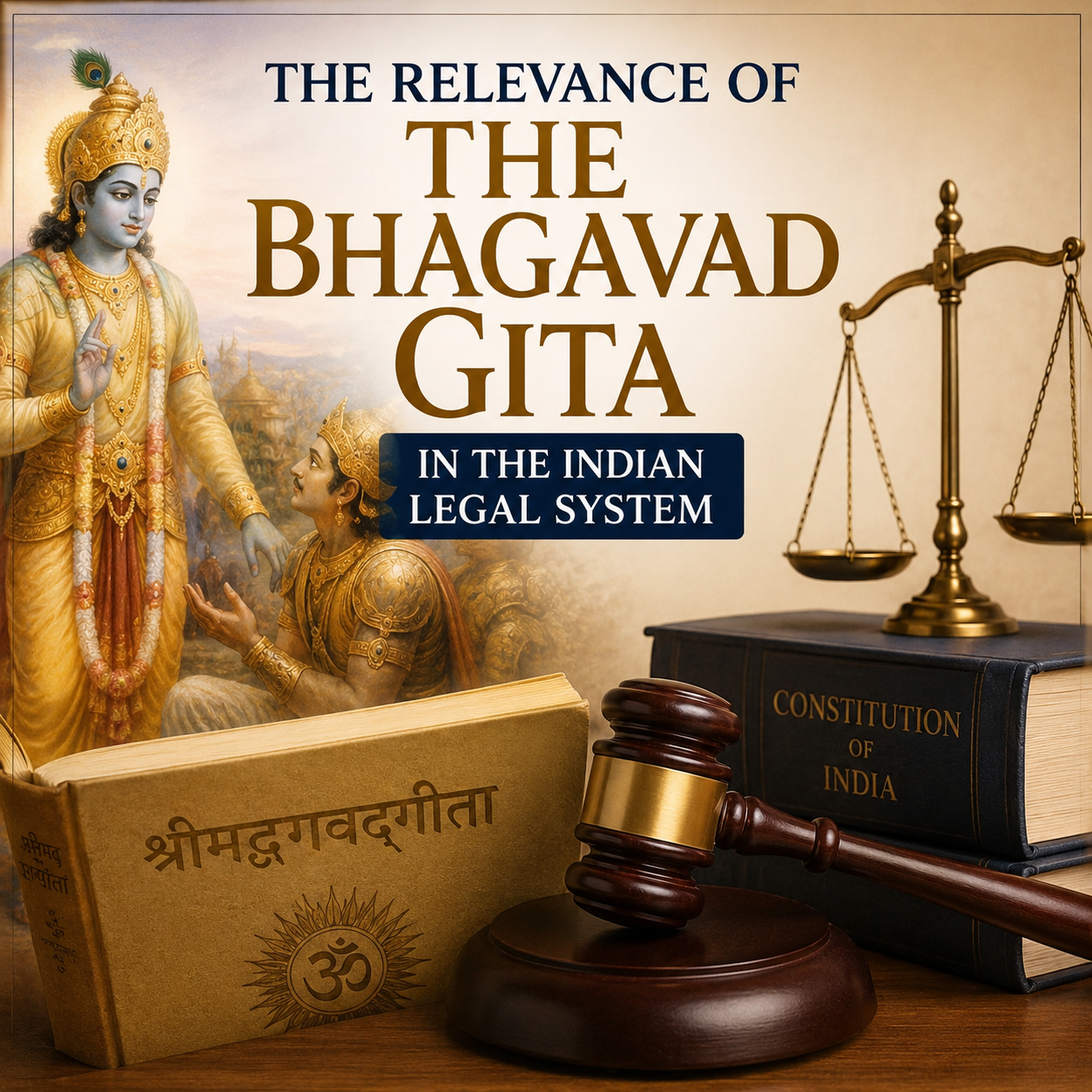
The Bhagavad Gita is this sort of spiritual dialogue between Krishna, who is not just an earthly deity, but also plays the role of a guide for Arjuna, on the battlefield of Kurukshetra. The real essence of it is not that it is some kind of legal code; rather, more like a compass for helping people make ethical calls, complete their obligations, and keep justice steady, all the time. The Indian Penal Code and the Constitution, with all their detailed statutory provisions, are the two main legal pillars. Meanwhile, a philosophical treatise like this great epic, the Bhagavad Gita, is more like a moral anchor that does not really age.
It brings us to multiple principles such as dharma, meaning duty, Nishkarm bhava, impartiality, and ethical restraint, which in a way can match the ideals of the Indian legal system, and can also steer the lawmakers, administrators, and judicial members to a decent degree. Law and morality have often been seen as being at odds, but still, the Gita keeps acting as a moral guide for lawmakers, judges, and lawyers, constantly nudging them toward what the law is actually trying to achieve—justice with fairness.
Dharma and Jurisprudential Resonance
The Gita identifies dharma as the key point. For Arjuna, it meant performing his dharma through war, though it pained him. Krishna explains, ‘Swadharme nidhanam shreyah, paradharmo bhayavahah’ (BG 3.35), meaning ‘That one should die performing his own duty rather than that of performing another’s duty which is full of danger.’ That is very applicable and relatable to a lawyer and a judge. Legal actors, regardless of how unpleasant the situation becomes, must keep alive the spirit of the Constitution and adhere to the law. That view of law as a means of social engineering – a means of achieving equilibrium in society- is similar to that of Roscoe Pound.
The concept found in the fundamental duties of the Constitution, Article 51(A) of the Fundamental Duties in Indian law, is that it is only by fulfilling their duties by individuals that the health of the legal system can be preserved. Like that, the Supreme Court in M.C. Mehta v. Union of India (1987)1 declared that it is every citizen’s duty to protect the environment, thereby demonstrating one of many examples of how one’s dharma is transformed into a legal obligation.
Nishkam Karma and Judicial Impartiality
The Bhagavad Gita is mainly praised for its message on performing actions without being attached to their results: “Karmanye vadhikaraste ma phaleshu kadachana” (BG 2.47), meaning “you just can have a right to perform the action, not to the fruits thereof”. This teaching practically coincides with the role of judges. In the matter of judging, they are not concerned with political ramifications or whether a decision could be publicly accepted or the case would personally benefit themselves. They are entrusted with the law and the facts to judge the matter. The Supreme Court emphasized neutrality as the foundation of justice when it comes to State of Punjab vs. Brijeshwar Singh Chahal (2016)2.
Counsel too ought to put forward truthful arguments with no other desire than to win but the desire to get justice served. Judges, as the Supreme Court in S.P. Gupta vs. Union of India (1981)3, should be independent, as that is the way to preserve the impartiality of the Judiciary. Judges are supposed to reflect the example set by Krishna, a detached performer, with dharma being the foundation of one’s act.
Conflict, Justice, and Resolution in the Gita
The Kurukshetra battlefield isn’t just a war scene; it is kind of a mirror for inner turmoil. Arjuna’s indecision shows those moral moments a judge goes through,or a parliamentarian and a lawyer too, like when every step feels ethically heavy. Krishna advises him, “Sukh dukh kotha vyaadhi saame bhavetha” (BG 2.38), as in: keep your mind steady, take pleasant and unpleasant things as they come, accept gain and loss, victory and defeat, and still move forward without sin. In the same way, balancing is needed in laws too, between individual rights and public needs, between liberty and security. Constitutional courts, like the ones in ADM Jabalpur v. Shivkant Shukla (1976)4, often have to walk that narrow path, because during the Emergency the suspension of fundamental rights turned into a real test for constitutional principles. Later, the Court even admitted its mistake, because blind or uncritical compliance with executive power was against dharma. And if you look at environmental jurisprudence, it also teaches this kind of equilibrium, for example Vellore Citizens Welfare Forum v. Union of India (1996)5, where the focus was on harmony between economic growth and ecological protection, which honestly feels close to the Gita’s way of thinking.
Ethical Foundations for the Legal Profession
The Gita highlights self-mastery and true character: “Yogasthah kuru karmani” (BG 2.48) means that one should work with determination and yoga, being stable, leaving behind desire and equanimity, facing both favorable and adverse circumstances. Lawyers are reminded here that law practice is not mere planning but representing truth. The Bar Council of India has established Rules of Professional Conduct mandating that legal practitioners should be fair and truthful, which are two values that find a deep harmony with the Gita teaching. A lawyer adhering strictly to these ethics will naturally choose a reasonable lawsuit and not an unprincipled one, present no misleading submissions, and do away with any show of theatrical flair. In Supreme Court Bar Association v. Union of India (1998)6, the judges affirmed that lawyers also work for the courts and should do what is right for society. In the same way, if a judge is detached from all desires and expectations, then such a judge will be unaffected by various influences and will be able to decide impartially. The Gita, that means, presents an old yet enduring moral system that is compatible with today’s law profession.
Contemporary Relevance in the Indian Legal System
On a bigger stage, the Indian judiciary is not uncommon for invoking the purest and the most beautiful aspects of human conscience, morality, fairness, and balance. The Constitutional Court of India, in the case Kesavananda Bharati v. State of Kerala (1973)7, announced, among others, the “basic structure doctrine” of the Constitution. The Doctrine, as explained, meant that Parliament is not empowered under the Constitution to destroy the core values of the Constitution completely. Here, Krishna’s promise is relevant: “Yada yada hi dharmasya glan bhavati Bharata, abhyutthanam adharmasya tadatmanam srijamyam” (BG 4.7), Whenever there is a decline of righteousness and rise of unrighteousness, I manifest myself.
Legally speaking, the judiciary “shows” itself and intervenes when constitutional morality is at stake to preserve the right to liberty and equality. In Navtej Singh Johar v. Union of India (Supreme Court of India)8 the Section 377 IPC was abolished to protect individual dignity. That court case was based on the higher dharma of constitutional morality. In the same way, the emergence of restorative justice is an echo of the Gita’s call for balance, cooperation, and reconciliation without giving any weight to purely punitive means. Mediation and arbitration are methods that Indian courts more and more advocate and through which the courts reach solutions in the way Krishna advised Arjuna – through reasoned persuasion rather than force.
Critiques and Limitations
Naturally, there could be a warning about this kind of move. A country like India, which is basically secular with many religious beliefs practiced among its citizens, using the Gita literally as a law book may not be a good idea, as it would upset a lot of people. Because of this, the relevance of the Gita can only come if it is logically universalized – not as a religious authority but as a moral guide, a source of ethics. In fact, teachings of the Gita like justice, fairness, impartiality, and selfless duty are not the exclusive property of one religion, but they are the shared heritage of humankind. Scholars like Upendra Baxi have cautioned against the use of religious writings as a matter of routine in secular legal reasoning, and this seems correct. The problem is to retain the core values without using the law to promote only one faith. A philosophical interpretation of the Gita instead of the one based on theology will be able to reveal the truths common to all humans, which can then support the pluralistic Indian Constitution setup.
Conclusion
The Bhagavad Gita is obviously not a legal text, but it is an eloquent philosopical companion of the law. In tying up duties, equity and justice, it gently guides the players of law back to their, and larger, duties. Judges, attorneys and legislators frequently find themselves in undertheorised ‘grey zones’ to which a purely technical rule-based approach cannot responsively respond. Here, the voice of Gita comes to their rescue and guides the law-giver to undertake her tasks with a gain of equanimity and dedication to a larger goal. As the law is being abused by reductionist, mechanistic and expedient regimes, Gita draws our attention to dharma- the divine impulse of the true spirit of law- such that law cannot be equated with the machinery. It is this reassuring sing-song of universal truths that makes the Indian legal system a true vehicle of justice.
- M.C. Mehta v. Union of India (1987) – A source is cited discussing citizens’ responsibility to environmental protection and how dharma is converted into a legally enforceable duty.
- State of Punjab v. Brijeshwar Singh Chahal (2016) – A case or principle is cited for the idea that neutrality is what forms a just judiciary.
- S.P. Gupta v. Union of India (1981) – Here, a source is cited for the significance of judicial independence as a means of achieving impartiality.
- ADM Jabalpur v. Shivkant Shukla (1976) – This case law has been referred to as an example of constitutional balance and also as a test of basic rights.
- Vellore Citizens Welfare Forum v. Union of India (1996) –Vellore Citizens Welfare Forum v. Union of India (1996) – This case has been cited as a way to show how economic development and environmental protection are both weighed up.
- Supreme Court Bar Association v. Union of India (1998) – Cited to confirm that lawyers are court employees who are duty-bound to justice.
- Kesavananda Bharati v. State of Kerala (1973) – Cited a case about the constitutional concept of basic features.
- Navtej Singh Johar v. Union of India (2018) – A judgment is cited where the court recognized respect for persons as a fundamental aspect of the Constitution.
- Besides this, the Constitution’s Fundamental Duties are mentioned via Article 51A and also the Rules of Professional Conduct of the Bar Council of India.
