
LAWS RELATED TO CUSTODIAL DEATH

This Article is written by Hitesh Bhootra, he is a 3rd-year LL.B. student at Aishwarya College of Education and Law. He also serves as an author at Lexful Legal.
Introduction
Custodial death represents an ultimate demonstration of State power misuse because it results in the death of an individual who remains under government custody. The law in India regarding custodial death has developed through constitutional protections, penal laws, procedural protections, and court decisions, which now require interpretation in light of the new criminal law system established by the Bharatiya Nyaya Sanhita 2023, the Bharatiya Nagarik Suraksha Sanhita 2023, and the Bharatiya Sakshya Adhiniyam 2023. The existing legal framework establishes both criminal responsibility and constitutional responsibility for acts of violence and deaths that occur during police custody, even though India lacks a complete anti-torture legislation.
Concept and Nature of Custodial Death
Custodial death describes the situation when someone dies while being held by law enforcement officers, judicial authorities, or any other legally sanctioned detention facility. The condition may develop because of either physical torture, lack of medical treatment, unlawful detention, improper monitoring, or psychological maltreatment, which results in suicide or physical breakdown. The state’s control over the victim’s physical freedom and personal safety creates a special situation that makes custodial death cases more serious than typical homicide cases. The explanation for such a death is more difficult for the State than it is for regular criminal cases.
Constitutional Framework
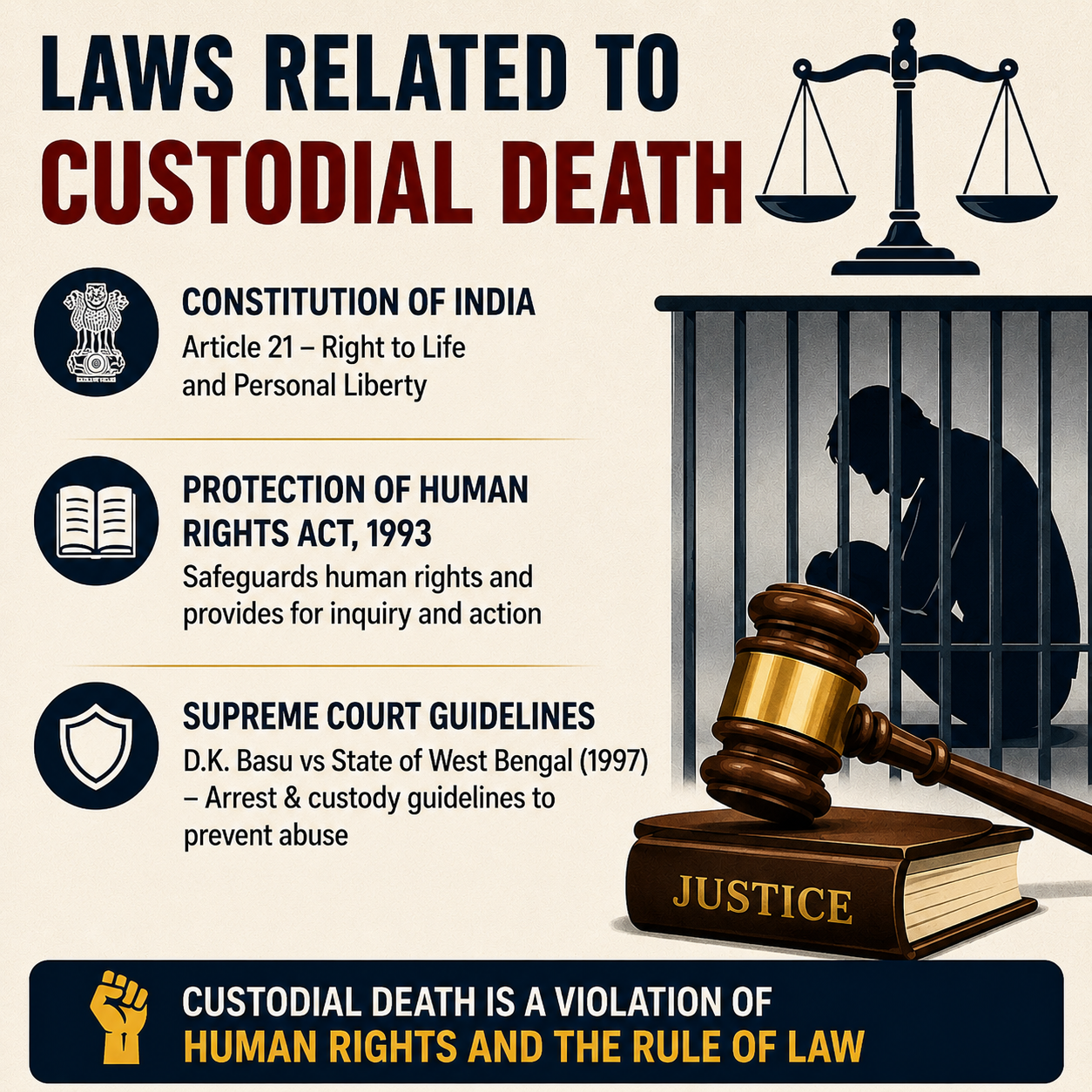
The constitutional framework that protects inmates from death in custody is provided by Articles 21, 20(3), and 22 of the Indian Constitution. Article 21 establishes that no individual may lose their right to life and personal freedom unless authorities follow established legal procedures. The Supreme Court has determined that torture and brutal treatment, and death during custody, violate this legal protection. Article 20(3) prohibits forced self-incrimination because it condemns police methods that use coercive techniques to obtain confessions, while Article 22 provides legal protection for people who face arrest and detention. The provisions establish that investigators must protect the dignity and physical well-being of defendants during criminal investigations.
BNS Provisions Relating to Custodial Violence
The BNS does not recognize “custodial death” as an independent offense because the updated substantive criminal law defines death and custody-related torture through its homicide and hurt provision. The BNS murder and culpable homicide provisions apply to officers who commit custodial violence, which results in death through their actual intent and knowledge, and the conditions that existed at that time. The new provision through section 120 BNS creates a penalty that punishes anyone who voluntarily inflicts hurt or grievous hurt to extract a confession or information that would help solve a crime or to return stolen assets. This section serves as the primary legal reference to handle custodial torture cases because it shows how a police officer uses violence to force a suspect to confess or reveal information. The BNS establishes new penal methods for law enforcement misconduct that results from torture while maintaining direct legal pathways to prosecute such police actions.
BNSS Provisions on Inquiry and Investigation
Section 196 BNSS establishes the current procedures for handling custodial deaths, which replace the previous CrPC rules that required magistrates to conduct inquiries in such situations. Section 196 requires that police officers who investigate a case must conduct an inquiry under a Magistrate’s authority when a person dies or disappears from police custody or any custody authorized by a Magistrate or court. The local police investigation, which exists as the only existing investigation method, fails to provide adequate independence in this case because police officers face suspicion of misconduct. Evidence can be recorded by the magistrate, inquiry powers can be exercised, and the body can be medically examined. Relatives can also be notified and involved in the proceedings whenever possible. This clause provides a framework for conducting investigations into custodial deaths without compromising evidence.
BSA and the Admissibility of Confessions
The Bharatiya Sakshya Adhiniyam, 2023 maintains the existing legal rule, which states that all confessions obtained through forceful methods lack valid evidentiary status. The unlawful approach that law enforcement uses to extract confessional statements functions as the primary reason behind custodial torture cases because officers seek to acquire confessional statements instead of legitimate evidence required for investigations. The BSA prohibits confession evidence that police obtained through inducement, threat, and coercion because this restriction prevents officers from using violent methods to extract information. Evidence law and human rights law function as interconnected systems that protect individuals from coercion because the Constitution prohibits this practice, while evidence law prevents the government from using such pressure to gain advantages in court.
Judicial Developments and Landmark Cases
D.K. Basu v. State of West Bengal is regarded as the most important judgment in this field since it considered custodial violence as the most heinous crime that could take place in a civilized society and created essential precautions that need to be taken by the people who are held under custody by the police. These guidelines require that police officers carrying out an arrest must provide their identity and that they must keep a record of the arrest while notifying their relatives or acquaintances immediately. The Supreme Court case of D.K. Basu maintains its ongoing significance because its principles exist as constitutional principles that maintain their active status after the legal transition from IPC and CrPC to BNS and BNSS.
In the case of Nilabati Behera v. State of Orissa, the Supreme Court held that if a custodial death has taken place, then it violates Article 21 of the Constitution, and the State will have to pay compensation. The decision established that essential rights protection through judicial remedies exists together with criminal proceedings and civil responsibility, which establishes its enduring value.
Recent judicial developments also show that the Court continues to insist on an independent investigation in serious custodial death cases. The Supreme Court moved the 2025 Deva Pardhi case from Madhya Pradesh to the CBI because it found police officers had interfered with the investigation, while their response to the situation had taken too much time. The judicial system requires both effective legal procedures and trustworthy independent execution to establish accountability for custodial death investigations, according to its current understanding.
Recent Updates and Reform Measures:
The most important recent legal update is the shift to the new criminal law framework of BNS, BNSS, and BSA, which now forms the statutory basis for dealing with custodial violence and death. The new system identifies section 120 BNS and section 196 BNSS as essential elements that establish the definition of torture used to extract confessions and the required procedures to investigate cases of custodial death. The Prevention of Custodial Torture Bill 2024 is a legislative measure designed to create a legal regime related to the crime of custodial torture through its punitive and compensatory mechanisms. Under this Bill, a person found guilty of custodial torture that leads to the death of the victim shall be sentenced to life imprisonment, indicating that lawmakers view custodial torture as a serious crime. The Bill serves as a reform measure that indicates the future path which Indian criminal justice system will proceed toward, despite not yet being enacted as law.
Conclusion
The Indian legal system has developed more organized rules about custodial death cases through its implementation of new criminal codes. The legal system maintains its essential foundation through Article 21, which protects human dignity. The BNS establishes actual crimes for both bodily harm and severe bodily harm and for murder. The BNSS requires that all custodial death cases undergo a magisterial inquiry. The BSA maintains its rule that all confessions obtained through force remain inadmissible in court. The Supreme Court established State responsibility as the primary element for legal procedures through its decisions in D.K. Basu and Nilabati Behera. The ongoing issues with custodial violence demonstrate that legal regulations require additional support from independent investigations, medical transparency, and judicial oversight
