
Mitakshara and Dayabhaga Schools of Hindu Law: An Overview

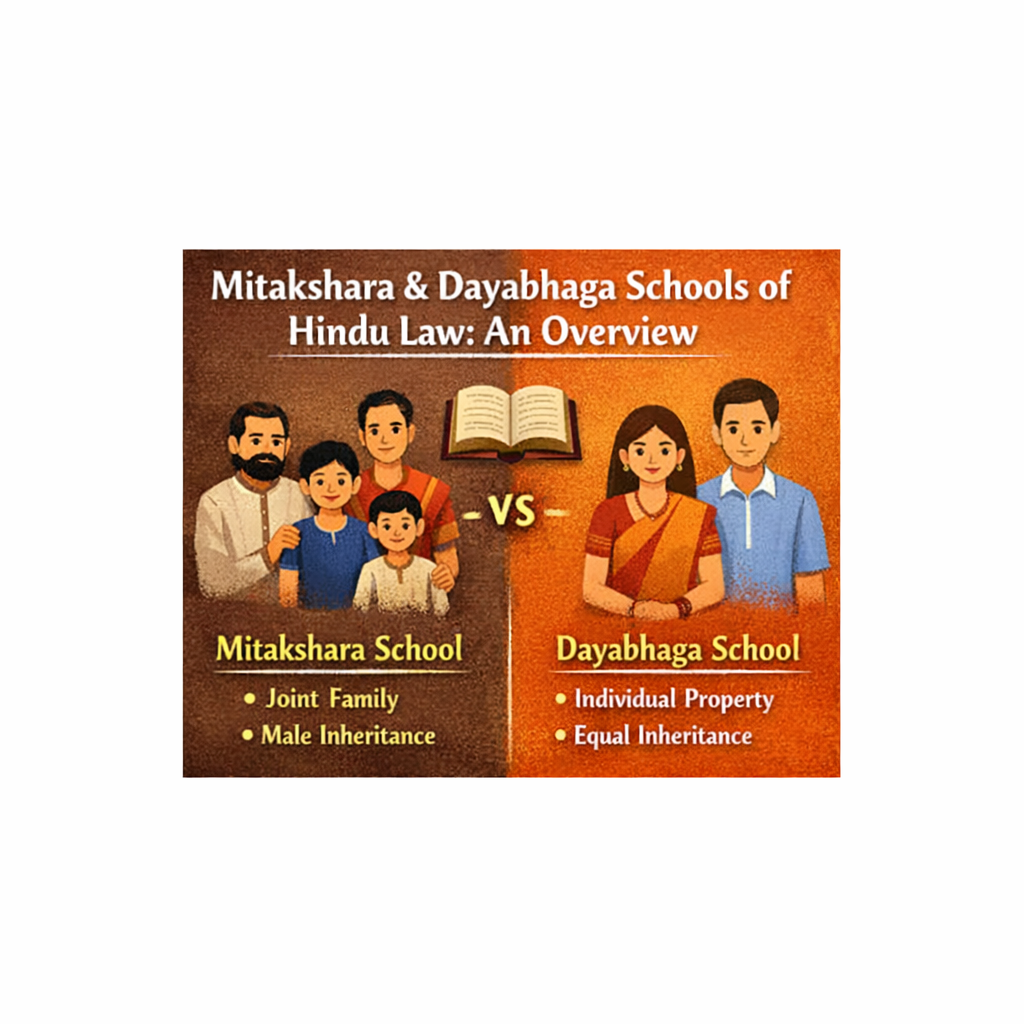
This article is written by Advocate Shivank Vikram Singh, an author at Lexful Legal, who regularly contributes legal insights and analysis on contemporary legal issues.
Introduction
Imagine two brothers born in 12th-century India. One is born in the arid plains of Maharashtra, the other in the river deltas of Bengal. Both are Hindu. Both live under the authority of ancient Smriti texts. Yet their property rights are fundamentally different, not because of caste or wealth, but because of geography.
The brother in Maharashtra acquires an ownership interest in his family’s ancestral property the moment he takes his first breath. The brother in Bengal acquires nothing until his father dies.
This is not a minor regional quirk. This distinction represents the doctrinal foundation of Hindu inheritance law for nearly a millennium. It stems from a single, pivotal question: When does a son become an owner?
The Mitakshara school answers: At birth.
The Dayabhaga school answers: At death.
These differing answers created two distinct legal universes within India. They defined family structures, dictated how taxes are paid today, and shaped the modern battles over gender equality in succession. Understanding this split is essential to interpreting modern Hindu law.
The Texts and Their Authority
The Mitakshara is not a standalone legal code. It is a running commentary (Tikav) on the Yajnavalkya Smriti, written by the scholar Vijnaneshwara in the 12th century. His interpretation became the gold standard for Hindu law across the entirety of India, with one major exception: Bengal.
The Dayabhaga, written by Jimutavahana (likely in the post-12th century period), took a different approach. It was not a commentary on a single text but a digest, a sophisticated synthesis of all leading Smritis. Jimutavahana argued that mere birth was insufficient to confer property rights. He reasoned that ownership must be tied to the capacity to perform spiritual duties (Shraddha or funeral rites). Since a living father performs his own rites, the son has no claim until the father passes.
While Mitakshara became the law of the land (subdivided into Benaras, Mithila, Bombay, and Madras schools), Dayabhaga reigned supreme in Bengal and parts of Assam.
The Core Doctrinal Split: Janmasvatvavada vs. Uparamasvatvavada
The technical terms for these theories are Janmasvatvavada (ownership by birth) and Uparamasvatvavada (ownership upon the cessation of the previous owner). These concepts drive three major legal differences:
1. The Nature of the Joint Family (Coparcenary)
Under Mitakshara, the “Joint Family” is a fluctuating body. A son, grandson, and great-grandson acquire a right in ancestral property by birth. They are called coparceners. The property is held jointly; no individual can say, “This specific acre is mine” until a partition happens. Crucially, if a coparcener dies, his share merges back into the family pot (doctrine of survivorship).
Under Dayabhaga, there is no such thing as a “birthright.” The father is the absolute owner during his lifetime. He can sell, mortgage, or gift the property without his son’s consent. A “Joint Family” only comes into existence after the father dies, when the brothers inherit the property together. Even then, they hold it as tenants-in-common with defined shares, not as a fluctuating coparcenary.
2. The Basis of Relationship (Sapinda)
Who counts as your heir?
▪️ Mitakshara relies on Propinquity (blood relationship). The closer you are by blood, the stronger your claim.
▪️ Dayabhaga relies on Religious Efficacy (Pinda-dan). The person who has the right to offer the funeral cake (pinda) to the deceased ancestors has the stronger claim.
This meant that Dayabhaga sometimes favored cognates (relations through females) earlier than Mitakshara did, simply because those relatives had specific ritual roles in Bengali tradition.
3. Partition
Under Mitakshara, a son can demand partition of ancestral property even while his father is alive, because the son is already a co-owner. Under Dayabhaga, a son cannot demand partition against his father. He has no right to enforce until the father dies.
Women’s Rights: Exclusion and Correction
Historically, both systems were patriarchal, but they marginalized women differently.
In the Mitakshara system, women were excluded from the coparcenary. Because property passed by “survivorship” to male members, a widow or daughter often received only a right to maintenance, not a share of the land (unless a partition happened).
Dayabhaga, paradoxically, was sometimes more favorable to widows. Since there was no “survivorship,” when a man died without sons, his share didn’t merge into his brother’s holdings. Instead, it passed to his widow. This gave Bengali widows property rights earlier than their counterparts in the rest of India, although their power to sell that property was strictly limited.
The Hindu Succession Act, 1956, tried to standardize this, but it retained the Mitakshara coparcenary concept. It wasn’t until the Hindu Succession (Amendment) Act, 2005, that the playing field was leveled. The Amendment made daughters coparceners by birth in Mitakshara families, granting them the same liabilities and rights as sons.
This shift was cemented by the Supreme Court in Vineeta Sharma v. Rakesh Sharma (2020). The Court held that the right is conferred by birth, meaning a daughter is a coparcener even if her father died before the 2005 Amendment came into effect. This ruling essentially dismantled the gender bias inherent in the classical Mitakshara model.
Why the Distinction Still Matters Today
One might assume the 1956 Act and the 2005 Amendment rendered these ancient schools obsolete. They did not. The Mitakshara-Dayabhaga split remains legally relevant in two key areas:
1. Taxation (The HUF)
The Income Tax Act recognizes the Hindu Undivided Family (HUF) as a separate taxable entity.
▪️ In a Mitakshara family, an HUF comes into existence automatically upon the birth of a son (and now, a daughter). The father and children are coparceners immediately.
▪️ In a Dayabhaga family, an HUF cannot exist while the father is alive, because he is the sole absolute owner. A Dayabhaga HUF can generally only be formed after the father’s death, by the heirs who decide to manage the inherited property jointly.
Tax planning strategies, therefore, differ entirely depending on whether the assessee is from West Bengal or Maharashtra.
2. Proof of Ancestral Property
In litigation, determining whether a property is “ancestral” or “self-acquired” often hinges on which school applies. The presumptions of jointness are stronger under Mitakshara. In Dayabhaga, since the father has absolute control, proving that a property was “blended” into the family pool is more difficult.
Conclusion
The Mitakshara and Dayabhaga schools represent two different visions of the family unit. Mitakshara views the family as a single, organic body where individual rights are submerged in the collective until partition. Dayabhaga views the family as a hierarchy where the patriarch holds absolute sway, and rights are individual and defined.
While modern statutes have overridden the discriminatory aspects of these schools, the underlying skeletal structure of Hindu law remains built on their foundations. Whether for tax purposes, succession planning, or understanding the evolution of women’s rights in India, the distinction between the “Right by Birth” and the “Right by Death” remains as vital today as it was in the 12th century.

Stackshine https://en.stackshine.io simplifies SaaS spend management with full software visibility, renewal tracking, and employee offboarding automation. Reduce costs, eliminate unused tools, and gain control over subscriptions with a smarter, centralized platform.
office space available offices spaces
Профессиональная: оклейка автомобиля пленкой – сохраните родное лакокрасочное покрытие в идеальном состоянии на долгие годы.
Tivat rent car Montenegro car hire Tivat airport
Montenegro yacht charter https://rent-a-yacht-montenegro.com
One thing I’ve noticed is that there are plenty of fallacies regarding the finance institutions intentions if talking about foreclosures. One myth in particular is the fact that the bank would like your house. The lender wants your hard earned dollars, not the home. They want the money they lent you along with interest. Avoiding the bank will still only draw a new foreclosed summary. Thanks for your post.
купить уличную камеру камеры видеонаблюдения уличные купить калининград
convert usdt to russian ruble https://exchange-usdt-cash.com