
UGC Rules 2026: When Indian Campuses Were Forced to Talk About Caste—Out Loud

This article is written by Advocate Shivank Vikram Singh, an author at Lexful Legal, who regularly contributes legal insights and analysis on contemporary legal issues.
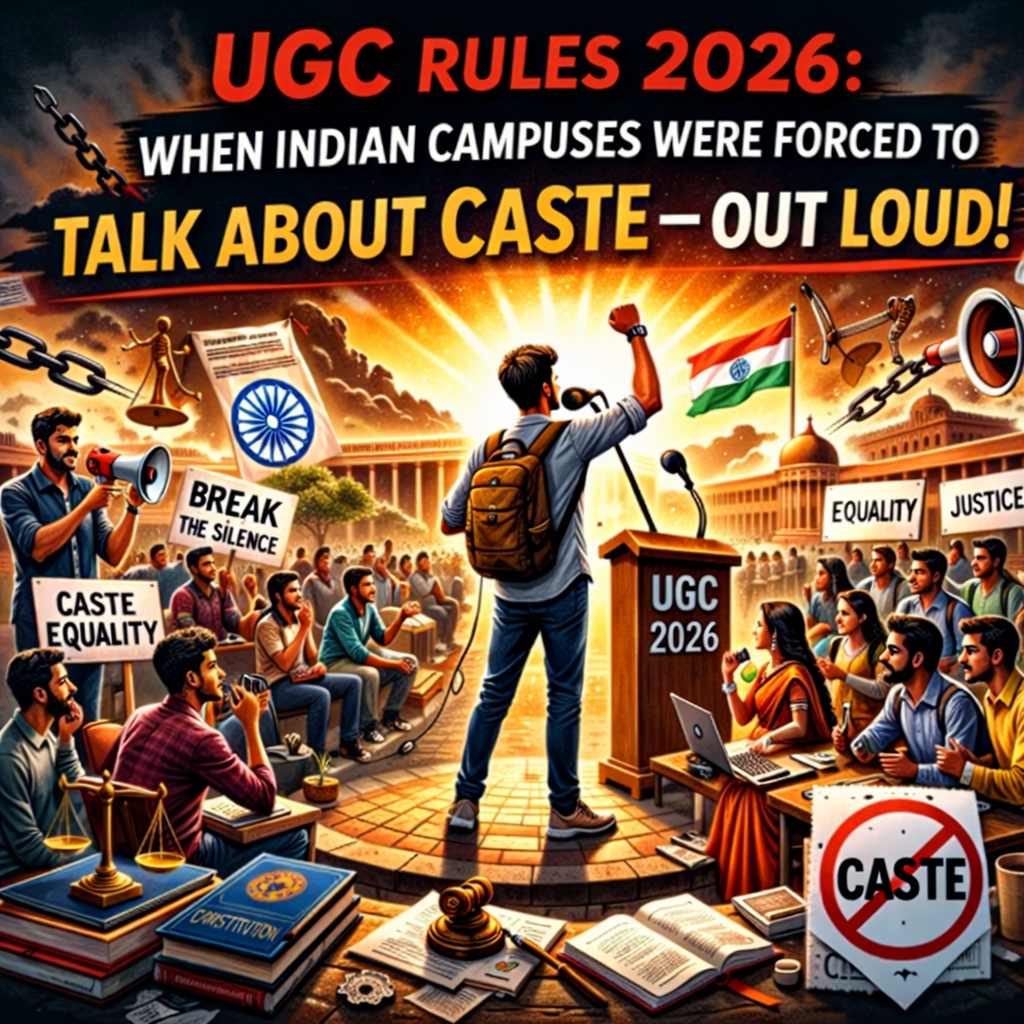
In early February 2026, something big happened. Indian campuses were forced to talk about the issue of caste, and talk about it loudly. The topic of caste, something not often discussed in public, was finally being brought out into the open on university campuses across India.
The Unspoken Reality
If you have spent any time on a university campus in India, you know the feeling. It’s in the silences, the invisible lines, the students and even teachers who are quietly pushed to the margins. In 2026, something shifted. Student unions in Delhi, Mumbai, and Bengaluru did not gather to protest fees or placements this time. They sat in, held the ground, and demanded answers on something far more uncomfortable—caste, and a promise of equality that had existed on paper for decades.
The New Regulations
The University Grants Commission (UGC) notified the Promotion of Equity in Higher Education Institutions Regulations, 2026 on January 13. These rules replace the toothless 2012 guidelines and make anti-discrimination measures mandatory for every college and university in the country.
What the Old Rules Looked Like
The 2012 version was basically a polite suggestion: set up committees, train teachers to be sensitive, maybe run some awareness programmes. Most universities ignored it. A 2019 parliamentary report found that 64% hadn’t even bothered forming the committees. Complaints of caste-based discrimination kept rising anyway—up 118% in five years, from 173 cases in 2019-20 to 378 in 2023-24. Many more go unreported.
What Changed in 2026
The 2026 regulations turned the volume up. They require every institution to:
- Set up an Equal Opportunity Centre with a dedicated Equity Committee (including SC, ST, OBC, women, and PwD representatives, plus civil society members and student invitees)
- Appoint a senior faculty coordinator to run it
- Run a 24-hour helpline
- Create “Equity Squads” and “Equity Ambassadors” in departments, hostels, and labs to spot problems early
- Hold annual bias-awareness training for all staff
Enforcement Mechanisms
The Equity Committee has to meet within 24 hours of a complaint and submit a report within 15 working days. The head of the institution must act within another week. Appeals go to an Ombudsperson.
Non-compliance can get a university debarred from UGC schemes, degree programmes, or even recognition under the UGC Act. That’s real pressure.
Expanding the Scope
The regulations explicitly bring Other Backward Classes (OBCs) under the umbrella—something the 2012 rules largely ignored. They define caste-based discrimination as unfair treatment on the basis of caste or tribe against SC, ST, or OBC members.
The Backlash
Critics immediately cried foul:
- “This only protects certain groups”
- “What about false complaints?”
- “It will scare teachers from giving honest grades”
Some of those fears are understandable. If 60% of students getting low marks in a class happen to be from reserved categories, does that automatically mean bias? Not necessarily—but the system now puts the onus on the teacher or department to show the evaluation was fair and objective. That shift in burden of proof feels uncomfortable to many who are used to the old way: complainant proves everything.
The Data Behind the Rules
Yet the data tells its own story. Dalit and Adivasi students still face higher dropout rates, lower fellowship access, and subtle exclusion from labs, research groups, and faculty positions. The regulations treat discrimination not as isolated incidents but as patterns embedded in everyday academic life—who gets the good project, whose paper gets fast-tracked, whose hostel room is “accidentally” in the worst block.
The Supreme Court Stay
Then came the backlash. Professors’ associations, student groups from the general category, and some political voices protested that the rules were one-sided and open to misuse. On January 29, 2026, the Supreme Court stayed the new regulations, calling them “vague” and potentially divisive. For now, the milder 2012 framework remains in force while the court hears the matter further.
Where Universities Stand Now
Most are in a holding pattern, but many have already started the groundwork because the direction is clear. Within the next couple of months they’re expected to:
- Appoint the Equity Committee and coordinator
- Set up the helpline and online reporting portal
- Run the first round of bias-awareness training
- Conduct a baseline equity audit of admissions, hostels, scholarships, and faculty hiring data
The Cost Factor
Smaller private colleges are quietly panicking about the cost and administrative load. A mid-sized state university could easily spend ₹8-10 lakh a year just on training, documentation, and the extra staff time. That’s real money when budgets are already stretched.
The Critical Question
Will this actually change anything on the ground?
If the regulations end up being weaponised for campus politics—frivolous complaints, score-settling, turning every grading dispute into a caste issue—they’ll collapse under their own weight and breed resentment.
If, on the other hand, even 10-15% more students from marginalised backgrounds feel safe enough to speak up when they’re being sidelined, if a few more Dalit or OBC scholars get fair mentorship, if a few more faculty members pause before making that casual “merit” remark that isn’t really about merit at all—then something fundamental will have shifted.
Conclusion
Indian higher education has pretended for decades that caste stops at the university gate. It never has. The 2026 regulations are an attempt to stop pretending. Whether they survive the courtroom and actually get implemented will decide if this is the beginning of genuine equity or just another round of performative bureaucracy.
The corridors are still divided. But at least now the rules say the division can no longer be ignored.
