
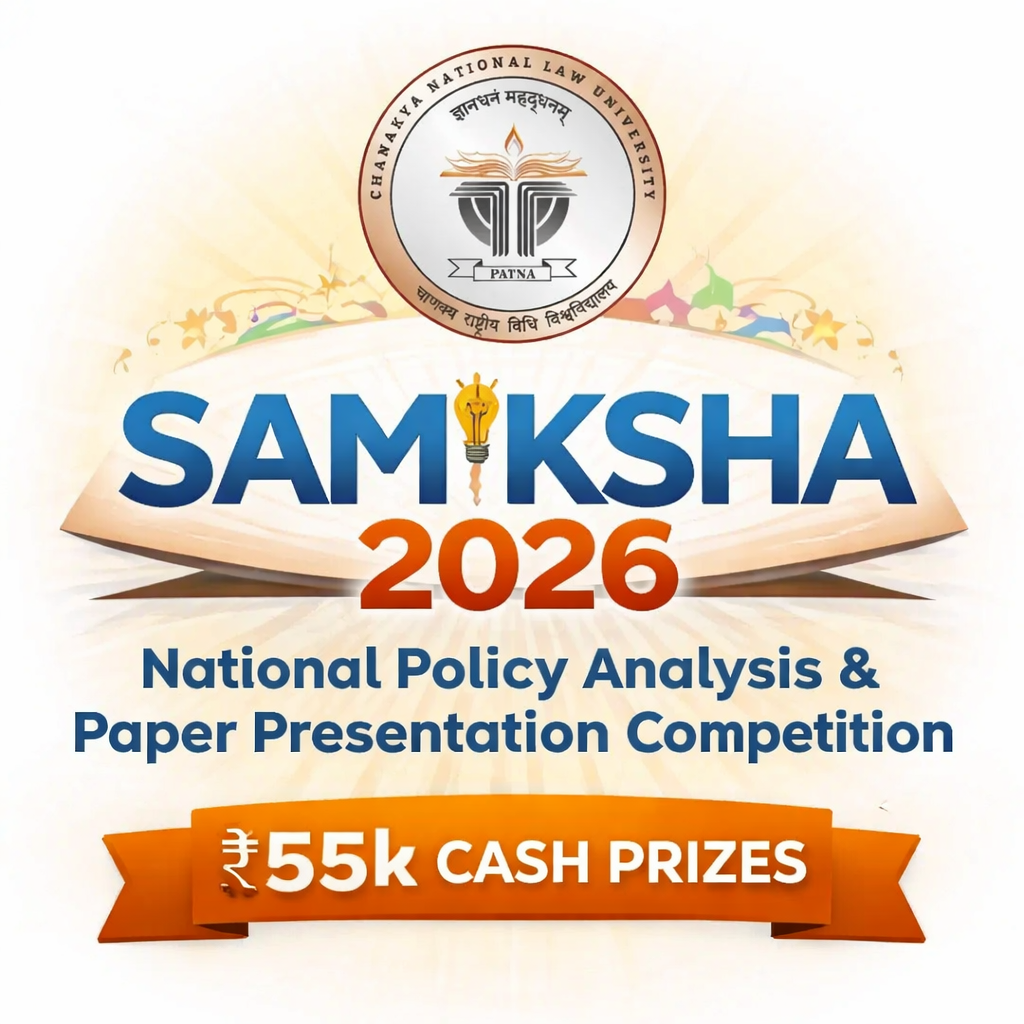
Samiksha 2026 – National Policy Analysis & Paper Presentation Competition

About the Organizer
The event is organized by the SC/ST Cell of Chanakya National Law University (CNLU). It is an annual academic initiative aimed at promoting research and policy analysis in social justice.
About the Event
SAMIKSHA 2026 is a National Policy Analysis & Paper Presentation Competition. Its objective is to empower scholars to engage with government welfare programs affecting marginalized communities and bridge the gap between policy and ground-level impact.
Themes & Sub-themes
- THE UNIVERSITY (UGC & STUDENT BENEFITS)
- Financial Inclusion in HEIs: Impact analysis of National Scholarship Portal (NSP) schemes and the efficacy of Direct Benefit Transfer (DBT) in reducing drop-out rates.
- NEP 2020 Implementation: Policy analysis of the Multiple Entry and Exit System (MEES) and its practical benefits for vocational students.
- Mental Health & Grievance Redressal: Evaluating the UGC’s “Utsaah” portal and the effectiveness of mandatory Internal Complaints Committees (ICC).
- UGC Equity Regulations 2026: Promoting Inclusion in HEIs.
- GENDER AND THE SC/ST COMMUNITY
- Reservation in Transition: Analysis of the Nari Shakti Vandan Adhiniyam (2023) and its expected impact on SC/ST women’s political participation.
- Institutional Equity: Evaluating the role of Equal Opportunity Cells (EOC) in universities and government workplaces for SC/ST students and staff.
- Economic Affirmative Action: Effectiveness of the Stand-Up India scheme and the National SC/ST Hub in fostering entrepreneurship among marginalized groups.
- Digital Gender Divide: Policy interventions to increase digital literacy and smartphone ownership among rural SC/ST women.
- LAW (LABOUR, ATROCITIES & SOCIAL PRACTICES)
- Labour Code Reform: Analyzing the transition from 29 colonial-era laws to the Four Labour Codes and its impact on the informal sector.
- POA Act Enforcement: A critical look at the implementation of the SC/ST (Prevention of Atrocities) Act—investigating low conviction rates and delayed justice.
- Gig Economy Regulations: The legal status and social security benefits for platform workers under new state labour laws.
- Modernizing Social Practices: Legislative efforts to curb practices like manual scavenging and the effectiveness of the NAMASTE scheme.
- ENTREPRENEURSHIP (ECONOMIC POLICIES AND JEEVIKA)
- JEEVIKA (BRLPS) & Women’s Agency: How the Bihar Rural Livelihoods Project has shifted the “Panchsutra” (five principles) into sustainable micro-enterprises.
- MSME Formalization: The impact of Udyam Registration on bringing rural “nano- entrepreneurs” into the formal banking system.
- Market Linkage Policies: Evaluating the role of e-NAM and Farmer-Producer Organizations (FPOs) in ensuring fair prices for SHGs.
- Venture Capital for the Grassroots: Analysis of the MUDRA Yojana and state- sponsored seed funds in scaling rural start-ups.
- TRIBAL EMPOWERMENT: RECONCILING LIVELIHOODS, LAND JUSTICE, AND FOREST GOVERNANCE IN SCHEDULED AREAS
- Forest Rights Act (FRA) 2006: conservation vs. livelihood
- Land alienation and restitution in scheduled areas
- PESA Act and tribal self-governance: 30 years later
- Judicial delays in NALSA tribal rights interventions
Who can submit?
- Undergraduate and postgraduate students from disciplines such as law, social sciences, humanities, environmental studies, and other related fields are eligible to apply.
- First-generation learners and students belonging to tribal and Indigenous communities are especially encouraged to participate
- Young researchers and interdisciplinary scholars working on topics related to law, justice, rights, culture, ecology, and Indigenous development are welcome.
- Students interested in presenting research papers, policy briefs or community-based case studies & research aligned with the conference themes shall also apply.
How to Submit?
- Step 1: Prepare the manuscript (in English, 4000-6000 words) in both MS Word and PDF formats.
- Step 2: Submit the research paper via email to scst@cnlu.ac.in
- Step 3: Use the subject line format: Team Name(s)_Title of Paper
Submission Guidelines
- Submissions are accepted only in the English language. Word limit 4000-6000 words
- Manuscripts must be in both MS-Word (doc./docx.) and .pdf format.
- All articles must be accompanied by an abstract not exceeding 300 words with five (5) keywords.
- The abstract must expressly include the novelty and usefulness of the idea that the author wishes to put forth, and must categorically mention the specific contribution of the article beyond the existing available literature.
- Only after the acceptance of Abstracts, the Authors shall be required to submit their full papers. The communication of acceptance shall be done through email only.
- Author(s) should not mention their personal details at any place in the Manuscript. Personal details and institutional affiliations should be mentioned in a separate cover letter.
- Co-authorship (with a cap of TWO authors) is permitted.
- Font type and size of the main text must be Times New Roman, 12.
- Font type and size of the footnotes must be Times New Roman, 10.
- The main text must have a line spacing of 1.5; Abstract & Footnotes line spacing must be 1.
- Manuscripts should only use footnotes as a means of citation. No other method shall be permitted. Citation style must adhere to Bluebook 20th edition format.
- The Editorial Board reserves the right to send the manuscripts back to the authors for any modification(s) at any stage. In the event of non-conformity with any of the submission guidelines, the Editorial Board may, in its absolute discretion, waive any of the above rules or amend the process.
- Authors are expected to provide original work with a plagiarism score below 10%. While up to 15% of the content may be refined or generated using Al, the technology cannot be used for substantive intellectual work. Your final analysis, interpretation, and conclusion must be entirely original and free of Al influence.
Important dates
- Official Opening of Registration: 4 February 2026.
- Final Date to Confirm Event Registration: 18 February 2026.
- Deadline for Submitting Abstracts: 21 February 2026.
- Last Date for Full Paper Submission: 9 March 2026.
- Presentation Day: 25 March 2026.
Fee
- Single Author: Rs. 300.
- Co-Author (max 2): Rs. 500.
- Accommodation: Rs. 1500 per person (including food, applicable if selected for presentation).
Perks & Benefits
- Winner – ₹20,000
- 1st Runner up – ₹15,000
- 2nd Runner up – ₹10,000
- 4th Excellence in policy writing- ₹5000
- 5th Best Oratory & Visual Delivery- ₹5000
- Publication Opportunity: Selected high-quality research papers will be published in the CNLU SC/ST Cell Annual E-Journal or Research Report.
- Academic Recognition: Participants receive national-level exposure and participation certificates.
Contact
Official Email: scst@cnlu.ac.in
