
Death Penalty: Indian Constitution & Global Trends | Legal Analysis

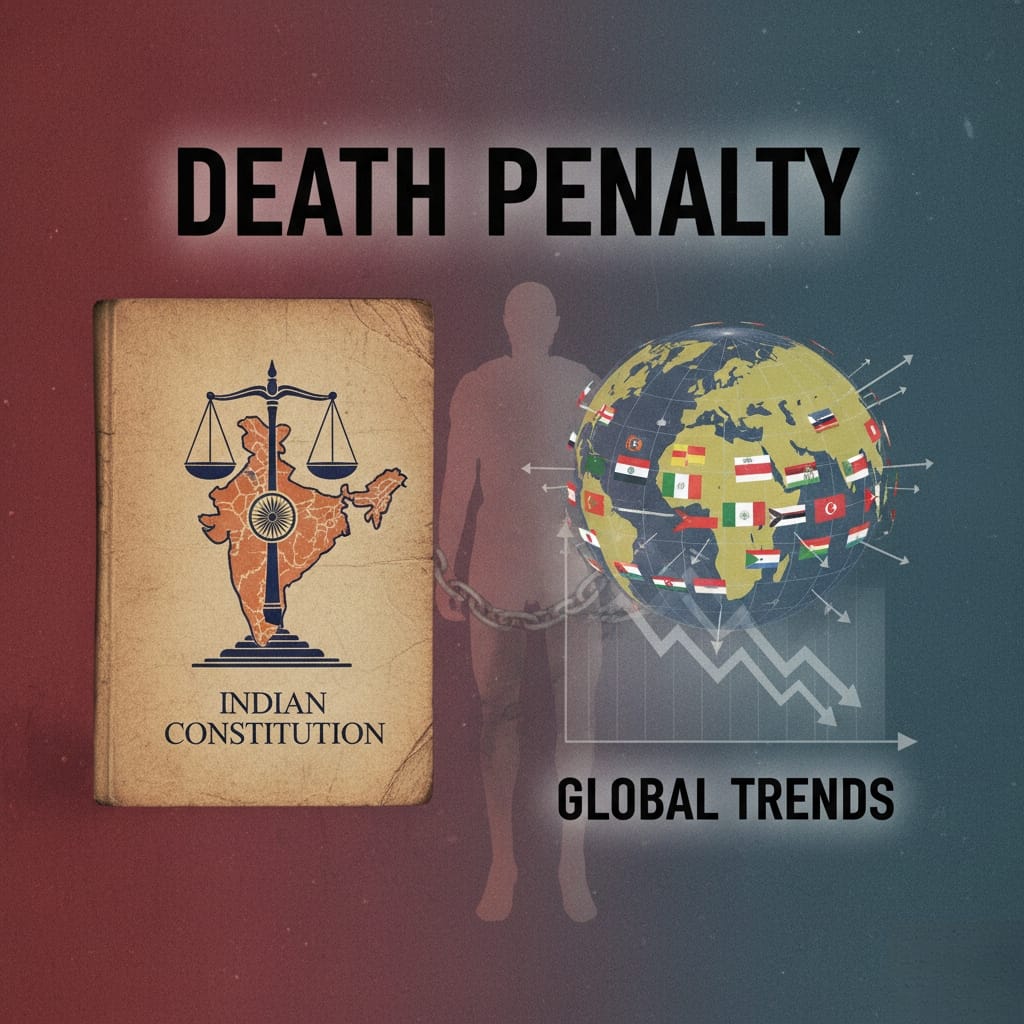
This Article is written by Disha Hirwani, she is a 2nd-semester LL.B. student at Aishwarya College of Education and Law. She also serves as an author at Lexful Legal.
ABSTRACT
The death penalty, or what we usually call capital punishment, is probably the most serious kind of punishment in criminal law and also one of the most argued about. In India, it has always been a tricky issue because of our Constitution. Article 21 promises the right to life and personal liberty for every person, but at the same time, it allows life to be taken away if it is done through a legal process. So, the debate is basically whether the death penalty goes against the spirit of Article 21, or whether it is still justified since the Constitution itself leaves that window open. The Supreme Court has not struck it down, but it has repeatedly said that it should only be used in the “rarest of rare” cases. So, life imprisonment is supposed to be the rule, and death is only the exception. But what counts as “rarest of rare” has always been a little subjective, and that is part of the whole problem. People who support it believe that for very brutal and extreme crimes, capital punishment is needed both to give justice to the victims and also as a kind of warning for others. But those against it say it is inhuman, it violates dignity, and most importantly, if the courts make a mistake, then the punishment cannot be taken back. They also argue that the purpose of punishment should be reforming people, not ending their lives altogether. Worldwide, the practice is shrinking. Many countries, especially in Europe and Latin America, have abolished it completely. But on the other hand, places like the US, China, and some Middle Eastern countries continue with it. So the global picture is a bit divided. The trend is clearly towards abolition, but it is not unanimous. This paper is just trying to see where the death penalty fits in our constitutional framework and whether it still has a place in today’s India. Should we keep hanging on to it just for extreme cases, or is it time we also thought about moving in line with the global shift against it? That is more or less what I am exploring.
Introduction
Capital punishment, obviously, it’s ancient. Like, the classic punishment. The state just… ending someone’s life. And back in the day, no one really questioned it? It was just a tool for power, I guess.
But now… we have human rights frameworks and everything. And you have to ask, is it ever okay for the government to have that power? Like, really okay? That’s the core of it, I think. In India, it’s been a debate forever. Since 1947, basically. The pro side… their points are simple. For the most horrific crimes—think terrorism, brutal rapes and murders—they say it’s a necessary deterrent. And it provides justice, or closure, for the victims’ families. I get that. For crimes that shock the whole society, a life sentence can feel… insufficient. Like, how do you even measure justice for something like that?
But. And this is a big but for me. The counter-arguments are heavy. It’s irreversible. What if we get it wrong? Our justice system isn’t perfect—far from it. There are biases, there are errors. And if we execute an innocent person… God, that’s a nightmare. There’s no undo button. Also, is revenge the same as justice? Shouldn’t the goal be reformation? But then again, can some people even be reformed? See, this is where I go in circles.
Then there’s the Constitution. Article 21 is a headache in this context. It says “right to life.” That’s it. The most basic right. But it has this caveat: “except according to procedure established by law.” So, the state can take life if it follows the right process. It feels like a contradiction, or at least a massive loophole. The courts came up with the “rarest of the rare” doctrine to limit it. But what does that even mean? It’s so vague. One judge’s “rare” is another judge’s Tuesday. The ambiguity is kind of the problem.
Globally, the trend is abolition. Most countries have ditched it. But not all. The US, China, Japan… they still use it. So, there’s no clear answer there, either.
So yeah. I don’t know. My essay is supposed to have a conclusion, but I’m not sure I do. Should India keep it for those extreme, unimaginable cases? Or are the risk of error and the moral weight of it too much? I’m honestly torn. Maybe the answer is that it’s supposed to be uncomfortable. If it was an easy question, we’d have solved it by now.
CONSTITUTIONAL VALIDITY
The constitutional validity of the death penalty in India… It’s a classic debate, and it all basically hinges on Article 21. Which, as we all know, is the big one: “No person shall be deprived of his life or personal liberty except according to procedure established by law.”
Now, this is where it gets tricky. On one hand, it’s literally called the right to life. It’s the most fundamental right, right? But then there’s that second part—the exception. “Except according to procedure established by law.” So, it’s not an absolute right. The Constitution itself seems to be saying, “Yeah, the state can take your life, but only if it jumps through the right legal hoops.” It’s not a ban; it’s more like a heavily regulated permission slip.
The Supreme Court’s journey with this has been all over the place. Initially, they were kinda like, “Yeah, it’s in the law, the process is there, so it’s fine.” But then, you can see their thinking evolve. They started getting really uncomfortable with it being applied too broadly. That’s where the whole “rarest of the rare” doctrine came from—which, let’s be honest, is a phrase that’s both powerful and super vague. It’s like the Court was trying to create a safeguard because they realised the finality of it is terrifying.
So now, the rule is that life imprisonment should be the default, and the death penalty is an exceptional thing. Judges have to go through this whole checklist—look at the crime, how it was done, the criminal’s background… the idea is to see if there’s something so awful, so shocking to society’s conscience, that nothing but death will suffice. Otherwise, it’s life in prison.
So, to sum it up, the constitutional position is this weird balance. The framers didn’t abolish it, and the courts have upheld it, but they’ve tried to build these massive walls around it. It’s a constant tug-of-war between protecting an individual’s right to life and giving the state the power to punish what it sees as the ultimate crimes. It’s not a clean answer, but I guess that’s the point—the law is trying to be careful with something so final.
CRITICISM OF THE DEATH PENALTY
The death penalty criticisms. Right. Okay, so, where do I even start? It’s one of those topics that just feels heavier the more you read.
Like, first—Article 21 of the Indian Constitution. The right to life. It feels so… fundamental, you know? It’s the bedrock. And then we have the death penalty. And part of me is just like, how can you square that circle? How can a right be a right if the state can just take it away? The “procedure established by law” bit feels like a loophole you could drive a truck through. It just seems like such a direct contradiction if you really think about it.
And then there’s the cruelty aspect. I mean, we’re talking about the state coldly planning an execution. However you dress it up, it’s… killing someone. It feels like we’re just mirroring the violence we’re trying to condemn. It’s weirdly primal for a modern legal system.
But the biggest thing for me, the one that actually makes my stomach sink, is the risk of getting it wrong. Our system is so… human. Cops can be biased, evidence can be contaminated, witnesses can lie. And if we mess up on a life sentence, there’s at least a chance to fix it. But with an execution? It’s over. Final. The idea that an innocent person could be put to death by the state… it’s literally a nightmare. It’s the ultimate, unfixable failure of justice.
And don’t even get me started on the deterrence argument. Like, where’s the proof? All the studies I’ve skimmed for class are super inconclusive. It seems more like an emotional argument—”it must scare people!”—than one based on any solid data. If it doesn’t actually work better than life in prison, what’s the point? Just retribution?
Which leads to the fairness issue. It’s so obvious it’s not applied evenly. It’s not about the crime; it’s about your lawyer, your money, your social class. It’s a punishment for the poor and the powerless. That’s not justice; that’s just… systemic bias on steroids.
And finally, the whole reform thing. Isn’t the point of prison supposed to be rehabilitation? Or at least, shouldn’t it be? The death penalty just slams that door shut. It says this person is beyond saving, beyond hope. That’s a pretty dark judgment for a society to make.
And then there’s the whole “Revenge vs. Reform” angle. This one really gets me. Like, in our criminology classes, we always talk about how a modern justice system should aim to rehabilitate, right? To actually, you know, fix the problem where possible. But the death penalty just… nukes that entire idea. It completely removes any chance for someone to change. It’s like the ultimate declaration that someone is beyond redemption. Which is kind of a bleak thing for a system of justice to decide. What’s the point if we don’t even believe in the possibility of change?
Oh, and I almost forgot a big one—the global perspective. It’s kind of awkward, honestly. Most of the world, especially all the countries we usually compare ourselves to, have abolished it. The UN is constantly pushing for abolition, saying it’s a human rights issue. So sticking with the death penalty sometimes makes India look a bit… out of step? It’s hard to ignore that we’re in the company of only a handful of countries that still use it regularly. Makes you think about what we’re valuing as a society.
So when you add all this up, it’s no surprise that the push to just get rid of it is growing. The alternative is already there: life imprisonment without parole. It’s still a brutal punishment, but it’s not… final. It at least keeps the door open for the slim chance of new evidence, and it doesn’t force the state to do the one thing it can never take back. It feels like a way to punish the crime without completely giving up on the principle that life has value.
GLOBAL TRENDS AND CRITICISM OF DEATH PENALTY
Looking at the global picture on the death penalty is actually really interesting. There’s been this huge shift over the past few decades. Like, the trend is super clear: the world is mostly moving away from it.
1. The Abolitionist Crew
So, more than two-thirds of countries have now abolished it, either officially or just in practice—they have it on the books but haven’t executed anyone in years. Pretty much all of Europe is abolitionist (except for Belarus, which is always the odd one out). Most of Latin America too. And even in Africa and Asia, you see more and more countries either debating it or just quietly stopping executions. It’s becoming the norm, honestly.
2. The Countries That Still Use It
But then you have the big retentionist states. The main ones always come up in debates: China, which is… yeah, we all know the numbers are probably huge but it’s all state secrecy. Then Iran, Saudi Arabia, Egypt… and then there’s the U.S., which always feels a bit awkward because it’s the only Western democracy that still regularly uses it, and even there it’s a patchwork of states. It’s a pretty specific group to be in, you know?
3. What International Orgs Are Saying
The big international bodies are firmly against it. The UN is constantly passing resolutions begging for a moratorium—like, a time-out—on executions, aiming for full abolition eventually. The EU is super vocal about it, too. Even treaties like the ICCPR, which India is part of, push states to restrict it. So on the global stage, supporting the death penalty puts you kind of on the defensive.
4. The Core Human Rights Arguments
The criticisms at the international level are pretty much the same ones we talk about domestically, just framed as universal human rights:
- It violates the most basic right: the right to life.
- It’s labeled as “cruel and inhuman treatment,” which is a big no-no under international law.
- The whole deterrence thing falls flat—no solid proof it works better than prison.
- And it’s applied in a messed-up, discriminatory way almost everywhere, targeting the poor and marginalized.
So globally, the debate feels kinda settled for most nations. It makes you wonder where India fits in this picture long-term, you know?
India’s POSITION IN COMPARISON WITH GLOBAL TRENDS
On one hand, you look at the map and see all these countries, especially in Europe and Latin America, that have just outright abolished it. And then there’s India, still holding on. So technically, yeah, we’re a “retentionist” country. But that label feels way too simple, you know?
Because it’s not like we’re using it all the time. The Supreme Court basically put it on life support with that “rarest of the rare” rule. It’s like they’re saying, “Okay, it’s in the toolbox, but we’re going to lock the toolbox and only open it in a total emergency.” So in practice, judges almost always go for life imprisonment. It’s the default.
The government’s usual defence is that we need it for the “shock the conscience” crimes—terrorism, really brutal murders. They argue it’s about societal justice, that some crimes demand this ultimate response to keep public faith in the system. And after, like, a really horrific terrorist attack, you can kinda feel that public anger. So the pressure is real.
But then, you look at the numbers and it’s like… we barely use it. The number of actual executions is tiny. It’s almost symbolic. It feels like we’re keeping it around more as a threat, a theoretical ultimate punishment, rather than something we’re comfortable actually doing. We’re not like China or Saudi Arabia, that’s for sure.
And there’s definitely this awareness of the global trend. The Law Commission’s 2015 report was a huge deal—it basically said, “Hey, maybe we should get rid of this, except maybe for terrorism.” But then it just… sat there. It’s like we have one foot wanting to move with the international human rights crowd, and the other foot stuck in “but what if we need it?” mode.
So we haven’t signed any UN moratoriums. The official stance is still “our house, our rules.”
Honestly, India’s position is super conflicted. We’re not all in, but we’re not getting out either. We’re stuck in this uncomfortable middle ground, trying to please everyone and maybe not really pleasing anyone. It’s like we know it’s probably wrong, but we’re too scared to completely let it go. Does that even make sense? It’s a weird place to be.
CONCLUSION
The death penalty is still this huge, unresolved debate, both here and everywhere else.
In India, it’s like we’ve built this really complicated fence around it. Article 21 gives us the right to life, but with a back door for the state. And the Supreme Court, trying to be the responsible adult, put up this “rarest of the rare” sign on that door. So yeah, it’s technically constitutional, but we’ve made it incredibly hard to actually use. It’s there, but it’s on life support.
Globally, though, the train has pretty much left the station. Most of the world sees it as a human rights violation, full stop. The international pressure is real.
And that leaves India in this awkward, in-between spot. We’re not abolitionists, but we’re not really retentionists in the same way as other countries that use it. We’re… hesitantly retentionist? It’s a constant balancing act between the theoretical need for ultimate justice for the worst crimes and the practical and ethical nightmare of actually carrying it out.
So where does that leave us? I honestly don’t know. Part of me gets the anger, the demand for justice in cases that are just unimaginable. But the other part can’t get past the finality, the risk of a mistake, and the feeling that maybe a state shouldn’t have this power.
Maybe the fact that it’s so debated, and that we feel so conflicted, is the point. It’s not supposed to be an easy question. For now, India’s compromise is to keep it on the books but barely use it—a symbol of severe punishment that we’re deeply uncomfortable with. It’s not a clean answer, but maybe it’s the only one we can manage for now.