
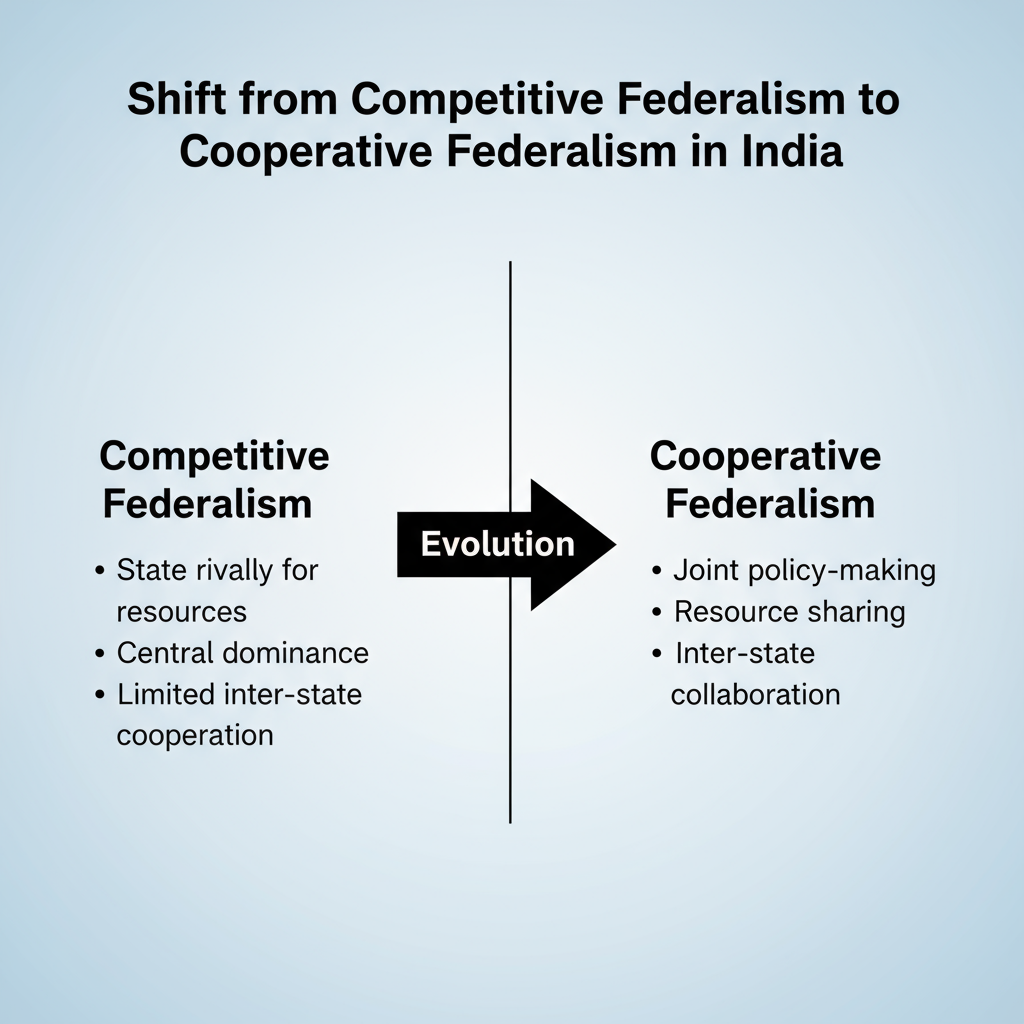
The way of Indian Constitution provides for a gradual shift from competitive federalism to cooperative federalism

This Article is written by Nimisha Borah, BALLB (H), 5th semester, Dibrugarh University, Assam.
Federalism is a system of government in which powers are shared between the Union and the states. The constitution of India is partly union and partly federal in character. It is not said to be a truly federal country. It is a quasi-federal system with a strong centralizing tendency (KC WHEARE), as the constitution of India was designed to create a strong center to maintain unity and integrity between the nation and the states. So, it is considered to be centrifugal in nature. Therefore, our constitution follows cooperative federalism, not competitive unlike the USA. Because cooperative federalism in India was a need, not a luxury. In State of Rajasthan V. Union of India,1977, the Supreme Court also held that the Indian model of federation is predominantly cooperative.
The makers of the Constitution endeavored to create a more synergistic governance by distributing essential powers and responsibilities to the center and states. Nevertheless, they vested power in the decision of parliament and the judgment of the supreme court. Thus, the center is provided with more specific powers, keeping the essence of cooperative federalism.
- The 7th schedule of the Constitution of India divided all powers between the central, state, and concurrent lists, giving some residual powers to the center.
- Secondly, the All India Services provided for a unified judicial system to establish the center and state laws. Article 312 of the Constitution of India manifests this provision that works on integration under cooperative federalism in India. Article 263 talks about an inter-state council to consider common interest factors between the states and the center.
- Article 261 also emphasizes full faith and credit to all records, public acts, and judicial proceedings of the union and state throughout the Indian territory. This step encourages faith and cooperation between the center and the states.
- There are 5 zonal councils for each zone, like central, north, south, east, and west, to promote coordination. These are designated under the State Reorganization Act of 1956, while the North-East Zonal Council is made under a district act.
However, the Constitution of India is a dynamic process with a constant interplay between centrifugal and centripetal forces. In recent years, several measures have been taken by the Indian government to promote cooperative federalism.
The acceptance of the 14th finance recommendations, apart from significantly enhanced devolution, enables states to design and implement programs better suited to their needs. So, government has established the Planning Commission and replaced it with NITI Aayog. One of the mandates of the NITI Aayog is to develop competitive federalism.
In 2017, the NITI Aayog called out for competitive “cooperative federalism,” stressing that this formula would redefine the relationship between the center and the states. Under the NITI Aayog, state governments would not look towards the center for policy guidelines and fiscal resources. Shares of states in central tax revenue have increased from 32% to 42% after the recommendations of the Finance Commission. States have the freedom to plan their expenditure based on their own priorities. In this way, given the greater scope for states to work together and learn from each other, it is obvious that for federalism to work well, these states must also fulfill their role in promoting the shared national objectives. Thus, the passage of the GST bill and NITI Aayog usher in a new era in cooperative fiscal federalism.
Nevertheless, competitive federalism is not yet embraced by all states, but a handful of states are clearly taking steps to strengthen their business environment. Hence, federalism is no longer the fault line of center-state relations but the definition of a new partnership of Team India.
These efforts of cooperative and competitive federalism have commenced but need to be strengthened. NITI Aayog concentrated on the broader policy framework instead of micro resource allocation functions. So, there is a need to take some further steps.
The Sarkaria Commission, 1987, and the Punchhi Commission,2010, also gave several recommendations to cultivate cooperative federalism and suggested actionable steps. Some of them include-
- Extending the mandate of the Inter-state council beyond advice and recommendations
- Including states when the centers enter into any international agreements.
Therefore, we can say that there needs to be a mixed competitive and cooperative federalism for India to move ahead. The future of India is competitive and cooperative federalism. Competitive federalism provides the dynamism that needs to be unleashed, and we need cooperative federalism to balance cooperative federalism. So, cooperative and competitive federalism may be two sides of the same coin, as competition alone cannot give the best results; it is competition with cooperation that will drive the real change for India.
