
The Impact of Early Marriage on Women’s Education, Jobs, and Money in India

This Article is written by Adv. Bhupendra Vyas, he is Outreach Manager of Lexful Legal.
Why Early Marriage Still Happens in India
In many parts of India, old traditions and strict family rules are still very strong. Because of these old customs, parents often force their daughters to get married at a very young age. They do this because they feel a huge amount of pressure from the people in their society, and they are always worried about keeping their family’s good name safe.
One of the biggest fears that parents have is that their daughters might fall in love and choose their own partner. In many communities, a love marriage is seen as a bad thing that ruins the family’s respect. To stop this from happening, some parents actually pull their daughters out of college or stop them from getting higher education. They think that if a girl gets too much freedom and learns too much, she will go out and find her own partner.
Besides this, families also worry a lot about a woman’s age. They think that if a girl gets too old, it will be very hard to find a good partner for her. Many people also believe that older women will have a lot of health problems when they try to have a baby. Even though parents think they are just protecting their daughters with these fears, they are actually doing a lot of harm. These actions stop a young woman from growing as a person, and it takes away her chance to get a steady job and make her own money.
How Early Marriage Affects Girls’ Education
When a girl is married off at a young age, her school life, collage life or further education usually comes to a fast stop. Once she becomes a new wife, she gets so many new duties. She has to do all the housework, deal with pressure from her husband’s family, and often gets pregnant or has to take care of babies right away. All of this takes up every minute of her day. Also, parents sometimes rush the wedding or stop college just because they are scared, she might fall in love if she keeps studying.
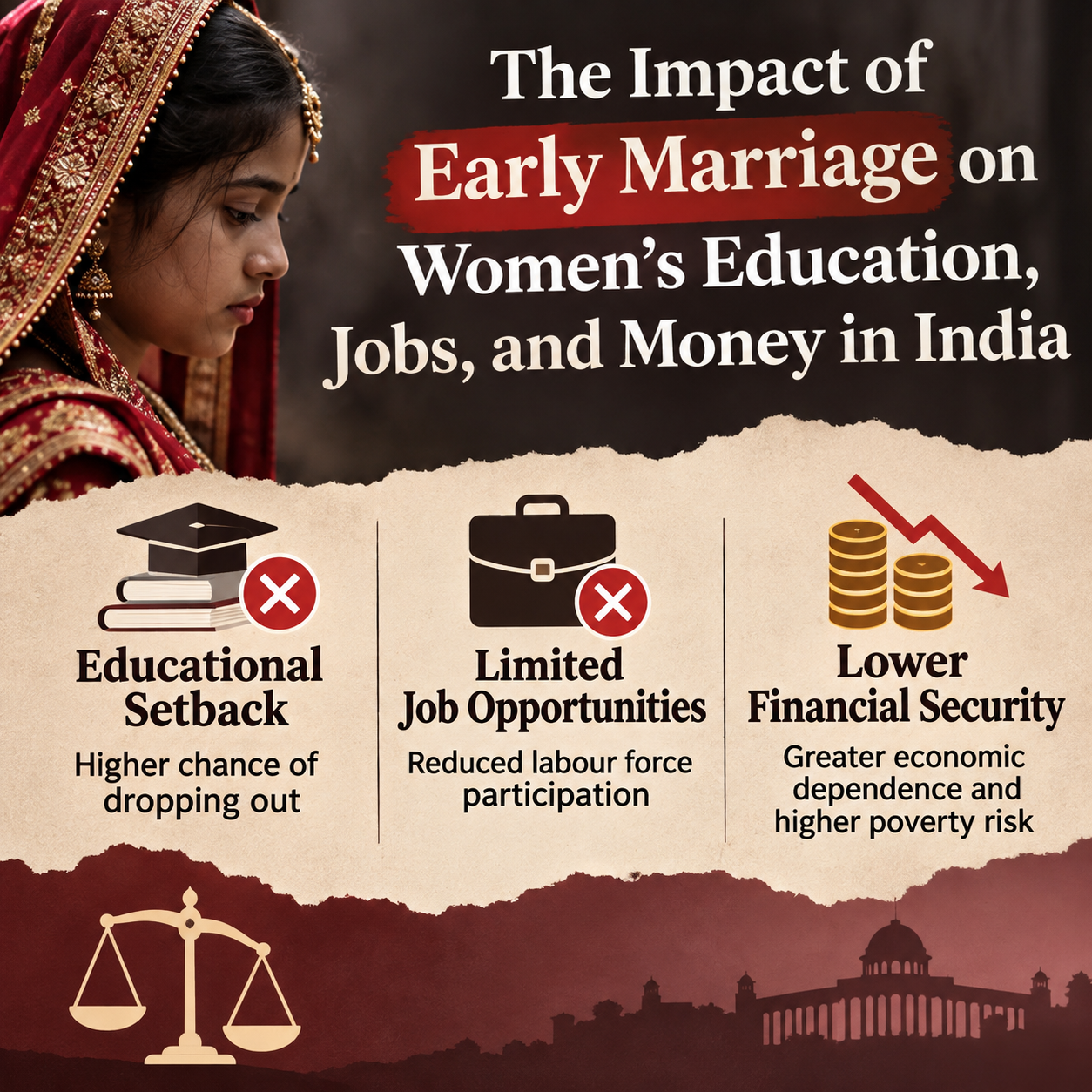
Education is the direct bridge to financial freedom. Leaving school early blocks a young woman from joining professional courses, cracking competitive government exams, or learning job skills. Later on, returning to books is very tough due to family duties and lack of support.
The Indian Constitution (under Article 21A) and the Right to Education Act of 2009 say that all children between 6 and 14 years old must get free schooling. But people need to remember that this law only pays for early school years. It does not give free college or higher education. Because college is not free and the woman is already busy with marriage, fixing this break in her education becomes almost impossible.
Early Marriage, Big Age Gaps, and Losing Out on Jobs
If a woman gets married before she finishes her studies, she loses her big chance to learn work skills, study for big exams, get practice at a job, and build her own career path. If she does not have a good education or any past work experience, finding a job that pays well is very difficult.
In many Indian families, parents look for a groom who is older than the girl because, they want a man who is already working and bringing home a good salary, rather than a young man who is the same age as the girl and still studying or looking for a job. Families do this because they want their daughter to be safe with money right away. However, picking a husband just because he is older and has money does not mean the marriage will be a happy one.
Having a big age difference between a husband and wife can actually cause a lot of problems. They might have different levels of maturity. They might disagree on how to spend money, who gets to make the big choices in the house, and how to share the daily chores. These differences often lead to arguments. If a young wife relies completely on her husband for every single rupee, she might not have any voice in big family decisions. This stress over money can cause terrible fights between the husband and wife. Sometimes, it even leads to them breaking up or getting a divorce. When a woman has no education, no job, and no money of her own, dealing with these sad life events becomes so much harder because she has no way to take care of herself.
Financial Dependence After Marriage: Why It Matters
When a young woman marries before finishing her education or getting a job, she usually has to depend completely on her husband or her in-laws for money. Because she does not have her own salary, her own savings account, or any control over the cash, she has to ask others for even the smallest, most basic things she needs.
Relying on someone else for money becomes very dangerous if something bad happens. For example, if her husband gets very sick, passes away, runs away from the family, or if the marriage completely fails. Trying to start life all over again during these dark times is incredibly difficult. It is even harder when she has little children who are looking to her for food, a safe house to live in, medicines, and school fees.
Trying to find a job when you do not have a college degree or any work experience is a huge mountain to climb. It becomes even worse if she has to watch small children all by herself without any help from her relatives. It is true that being a housewife is very hard work, and doing household chores is very valuable. However, because this work is not paid, having zero money in her own name creates huge dangers during emergencies. When a woman has her own education, some money saved up, and knows how to manage money, she builds a strong safety net. This makes sure she can feed and protect herself and her babies when bad days come.
The Legal Rights of Women Who Depend on Others for Money
When marrying young causes money problems, or leaves a woman all alone with no support, the laws in India give her some very important protections. Depending on what her life looks like, a wife who cannot make her own money can go to court. Under Section 144 of the Bharatiya Nagarik Suraksha Sanhita of 2023, she can ask the judge to make her husband pay her money every month for her living expenses.
Also, if a woman is being hurt, beaten, or mentally tortured at home, she can use the Protection of Women from Domestic Violence Act of 2005. This law helps her get fast legal help, court orders to keep her safe from the abuser, and a secure house to stay in. On top of that, every single woman has complete legal rights over her “stridhan.” Stridhan means all the gifts, cash, jewellery, and expensive things she was given during her wedding. These things belong only to her. Her husband and his family are never allowed to take them away from her.
Many times, women do not go to court because they do not have the money to pay a lawyer. Because of this, the Legal Services Authorities Act of 1987 was created. This law makes sure that women who qualify can get free legal advice and a free lawyer. This ensures that a lack of money will never stop a woman from getting the justice she deserves.
What Changes Do We Need to Make?
To keep young women safe and to make our society much stronger, we need to make a lot of good changes in our families and our neighbourhoods. First of all, families and local leaders must loudly encourage girls to finish all their schooling. Girls need time to build their confidence before making massive life choices like getting married. Instead of pulling a girl out of school because they are scared, she might fall in love, parents should talk to their children openly. Building trust and talking nicely will guide children in a much safer way.
Next, towns and villages need to offer more ways for girls to learn practical work skills. There should be job training and people to give advice on careers so young women can easily find good jobs. We also need to teach women how to handle money. Teaching them how to save cash, how to use a bank, and what their legal rights are will help them manage their own lives without needing anyone else.
Before a man and a woman get married, they should sit down and talk honestly about money, how they will pay for things, how they will raise kids, and what their job dreams are. Doing this will stop big fights from happening later on. Finally, we need to spread more awareness about the law in local areas. If communities work hard to fight against child marriage and teach families about the law, parents will choose a brighter, safer, and happier future for their daughters.
The Important Job of Families and Neighbourhoods
Making a safe, happy, and peaceful world for young women takes hard work from both parents and the people living in the community. Parents have a huge job to do. They need to learn that a girl’s education and her ability to make her own money are just as important as getting her married. Families must also stop thinking that marrying their daughter to an older man, or a man with a big salary, will magically give her a safe and happy life. Real happiness in a marriage comes from treating each other with respect and understanding each other, not from how old the man is or how much money he has.
Schools, colleges, and local community clubs need to work hard to share useful information. They should teach parents and young people about women’s legal rights and the different jobs they can do. Inside the house, husbands and wives must respect what the other person wants to achieve in life. They should support each other’s dreams and split the daily cleaning and cooking fairly.
The main lesson to take away is very simple: Getting married should never stop a woman from learning, earning her own living, making her own life choices, and living with respect and dignity.
