
Why India’s Universities are Failing the ‘Vishwaguru’ Test

This article has been authored by Alexander A. Kumar, who is currently pursuing a B.Tech degree at South Asian University.
OPINION/SOCIAL COMMENTARY
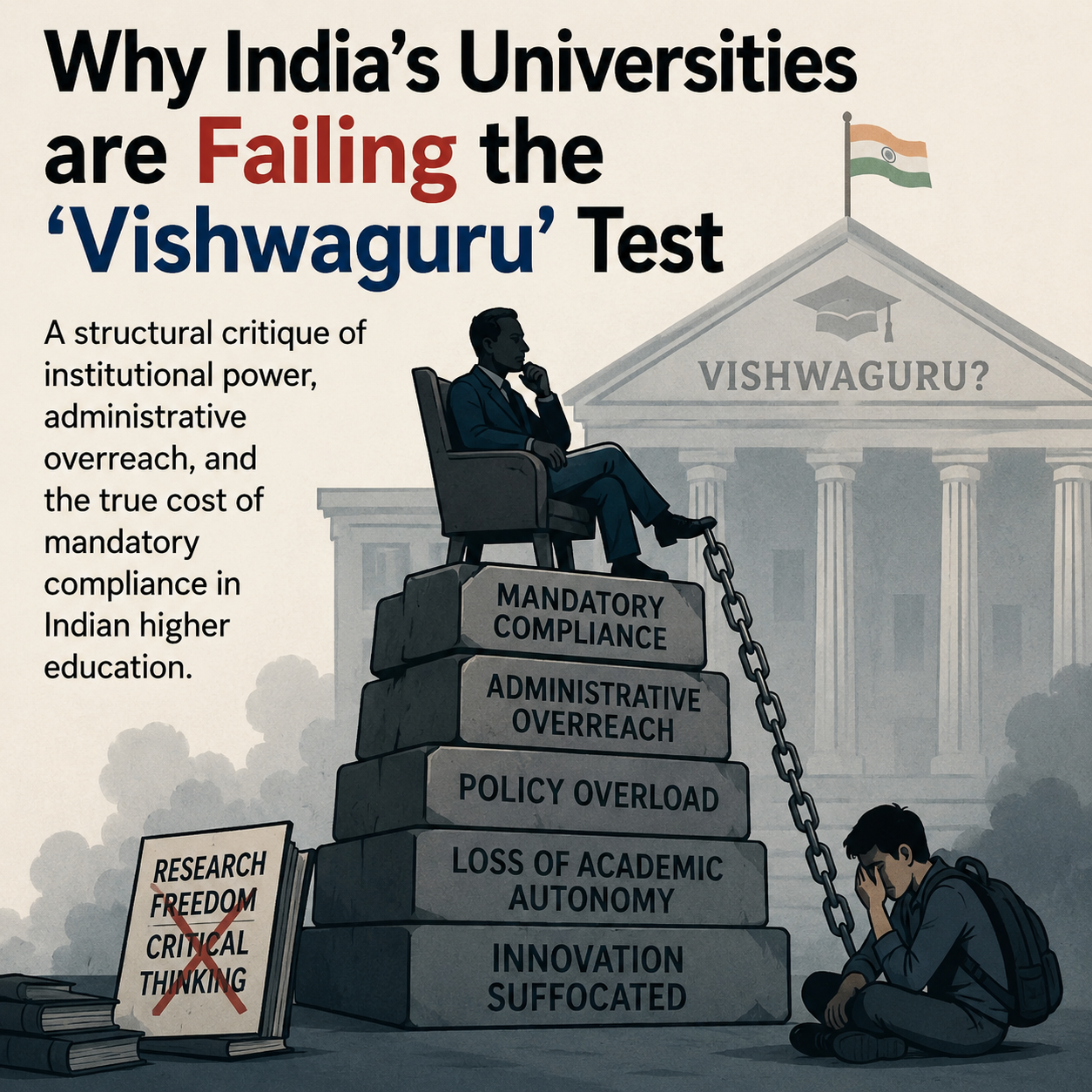
A structural critique of institutional power, administrative overreach, and the true cost of mandatory compliance in Indian higher education.
The term “World Teacher” (Vishwaguru) is widely used in contemporary policy discourse, a concept that conveys immense civilizational confidence. Yet, while India might have been a historic exporter of knowledge, a realist examination of our present academia reveals a profound institutional decay. As new academic sessions begin across the country and debates around the National Education Policy continue, we must confront an uncomfortable truth: the current Indian academic framework functions as a structurally flawed system that continuously compromises the intellectual growth of its students
THE COST OF MANDATORY COMPLIANCE
To understand this decline, one must look past generalized complaints about teaching quality and analyze the university as a system of power and incentives. When mandatory 75% attendance policies become the sole metric of academic engagement, they incentivize mere physical compliance rather than genuine intellectual inquiry. In classrooms where fundamental concepts are frequently left unexplained, this rigid scheduling traps students
in a cycle that consumes their time while yielding negligible intellectual returns. When administrations prioritize institutional control over pedagogical outcomes, the curriculum itself becomes a mechanism of containment. Under the guise of broad development, unnecessary and peripheral courses are added to the academic roster, designed not to enlighten, but to occupy. The university, acting primarily to preserve its own authority, demands strict “discipline” from its students. This demand is enforced by making classroom attendance an absolute prerequisite for sitting the semester exams.
It operates as a system of behavioral conditioning rather than academic exploration. Consequently, the sheer volume of time wasted within these institutional walls is staggering. Students find themselves trapped in lecture halls for hours on end, enduring a performative charade of learning where no actual intellectual transfer occurs. This temporal exhaustion neutralizes student agency, leaving them with little energy to pursue meaningful, independent inquiry.
The situation has structurally deteriorated to the point where many students realize they can learn more efficiently through self-directed study and Artificial Intelligence (AI). Currently, students attend classes primarily to fulfill bureaucratic criteria. This dynamic reduces universities to a lighter version of rote-learning coaching centers, giving rise to “disguised education”-a phenomenon where learning exists merely on paper, but the actual development of critical thinking and analytical agility is heavily suppressed.
GRAVEYARDS OF RATIONALITY
Institutions that were established to incubate ideas have instead become graveyards of rationality and innovation, their primary purpose hijacked by institutional politics. The systemic failure does not simply stem from professors who are unable to teach; rather, educators are forced to operate as rational actors within a deeply flawed bureaucratic environment. Instead of pursuing academic excellence, faculty energy is entirely drained by the necessity of appeasing the administration, chasing arbitrary metrics, managing excessive paperwork, and navigating endless departmental red tape. This dynamic creates a high-pressure environment focused on institutional survival, leaving little room or incentive for actual mentorship or groundbreaking research. The modern university administration has, in effect, centralized power at the expense of academic liberty.
A STRUCTURAL SOLUTION
If India truly desires to materialize the “World Teacher” narrative, it urgently needs to execute structural reforms rather than relying on rhetorical flourishes. A crucial, actionable policy step would be to cleanly separate the research and teaching tracks, at least up to the undergraduate level. This dual-track system would allow dedicated educators to focus entirely on pedagogical excellence and student mentorship without the looming threat of
“publish or perish.” Simultaneously, it would liberate researchers from forced classroom quotas and administrative bloat, allowing them to focus entirely on rigorous, groundbreaking work. Only by reforming the systemic incentives and dismantling the bureaucratic overreach can we empower both students and faculty, eventually reclaiming our status as a global leader in education.
