
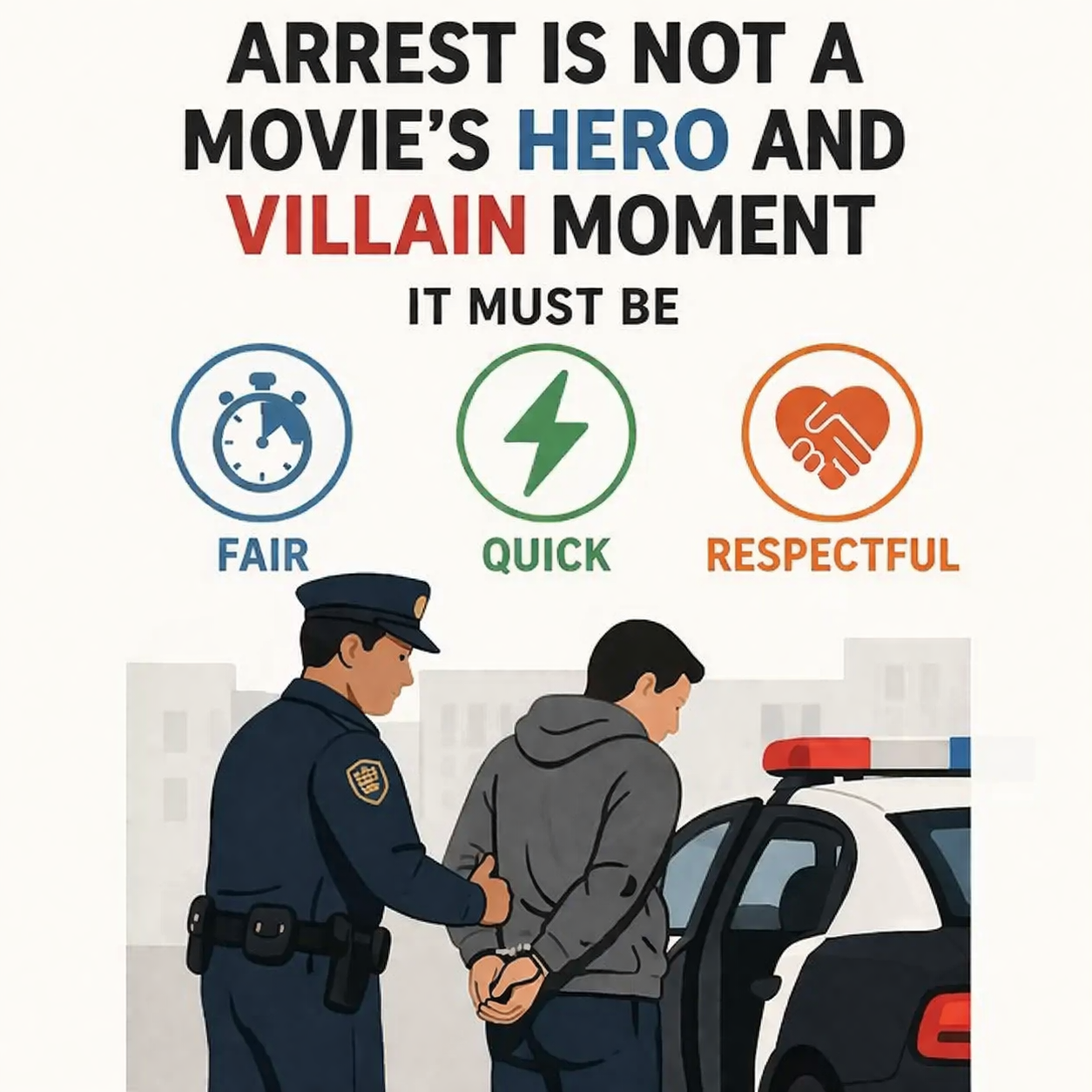
Arrest is not a movie’s hero and villain moment it must be fair, quick, respectful.

This Article is written by Disha Hirwani, she is a 2nd-semester LL.B. student at Aishwarya College of Education and Law. She also serves as an author at Lexful Legal.
Sometimes, police turn it into a circus, but this is a clear violation of the rights of any arrestee.
1) Right to know exactly why they have been arrested
Given in Article 22(1) and Section 47 of BNSS.
The law says that when police stop you, they must tell you in this moment only why you have been arrested, for what crime, in a language which is understood by you understand. No secrets. So that you can call your family lawyer because the law says that the procedure must be followed.
But sometimes they don’t talk, they just grab you straight to the station gate and make you sit on the floor outside, everyone walking by staring at you, camera click-click.
But psychologically, it affects the arrestee’s mental health so much. Like what have I done? Family is waiting at home.
Then the arrestee may lie under this pressure. They can give fake confessions because there is a fear as mental breaks occur little by little.
In the Islam Khan case, many poor men sat like this and later said that they signed papers blindly. The court said that this is a tricky attack on the mind and not a real arrest, as our constitution says you are human with a brain.
2) Right to respect and no hurt or shame
(Article 21 and Section 55A of BNSS)
The law says the right to live with dignity means a good life with honour and no hurt body, no hurt feelings.
In the case of DK Basu v. West Bengal gives guidelines already.
But making arrestee sitting at the gate or front door for one or two hours, such hot, people point fingers, laugh, curse you and worse part is remove shirt and pants, sit like this arms up, colored camera flashes then share pics.
But it hurts so much, and it is a real human pain, feeling like naked, feeling wanted to die.
Eyes down as someone stripping your dignity.
Wives hear village talk like this that your husband is a criminal when they have not even reached the courts yet. Kids hear “your dad is a criminal.” They are just arrestees yet but people treat them as they are criminals.
The principle of “innocent until proven guilty” has been completely shattered because from now no one will see them as innocent.
Police have guns and we are so small. Without respect, they become bully kings. Human heart is fragile; one shame breaks you forever. But the law says arrest for finding the truth not punish before court trials.
3) Right to privacy – keep your face and story secret
(Article 21 and Section 3–6 of Prisoners Act)
Law says if police want photo or finger print then ask for court’s judge first and judge also say yes for police file only which should be black and white, no colours, no fancy. No need to show name and face to the world until final guilty in the court.
But one photo is public stamp criminal on forehead forever.
If someone Google may be your 10 yrs old pic is already there. Even innocent but people treat you like criminal.
Police usually click coloured photos send to the newspapers, WhatsApp groups, posts on Insta with caption “caught thief’s” goes viral 1000 shares a day. Will treat the police like heroes and the arrestee as a villain, but he has not proven guilty yet.
Pics on WhatsApp and TV shout like a big criminal has been caught by the police, “Aaj ki taaza khabar.” See photo of the arrestee. People hate for no personal reason. Before a court trial, everyone thinks guilty first.
Arrestee’s house and family face a stone’s throw, shop boycott.
Suggestion for guidelines
- Arrest inside and private.
No gate sits near the crowd.
If it does, then punishable by a 50K fine, and can also suffer transfer.
- Tell crime first, paper.
If not, then the case becomes weak and can be suspended.
- Photo and sign with the judge’s permission.
Black and white. Use only for filing, not sharing.
4. If it does, then delete within 24 hrs and FIR section 354.
5. News of crime, only no name and pic.
If it does, then contempt of jail.
6. Arresting women lady cop only.
If not, then big jail IPC.
7. Delay in presence in front of the magistrate then it can amount to Habeas free man.
By the case of Satendra Kumar Antil v. CBI, 2022
SC= Arrest an Exception-Notice Under Section 35(3) BNSS Mandatory for Offences
Punishable Up to 7 Years
The Supreme Court reiterated that an arrest should not be made routinely in offences punishable with imprisonment up to seven years and that personal liberty must be protected during investigation. Interpreting the scheme now reflected in Section 35 BNSS, the Court held that the police must first consider whether an arrest is necessary and satisfy the statutory conditions before exercising such power. It emphasized that issuance of notice of appearance (now under Section 35(3) BNSS) is the normal rule, and arrest should be used only when justified by circumstances such as non-compliance with the notice
The Court clarified that the word “may” in the arrest provision indicates discretion and not compulsion, and reasons must be recorded to justify arrest. Thus, arrest is an exception while notice is the rule in offences punishable up to seven years
