
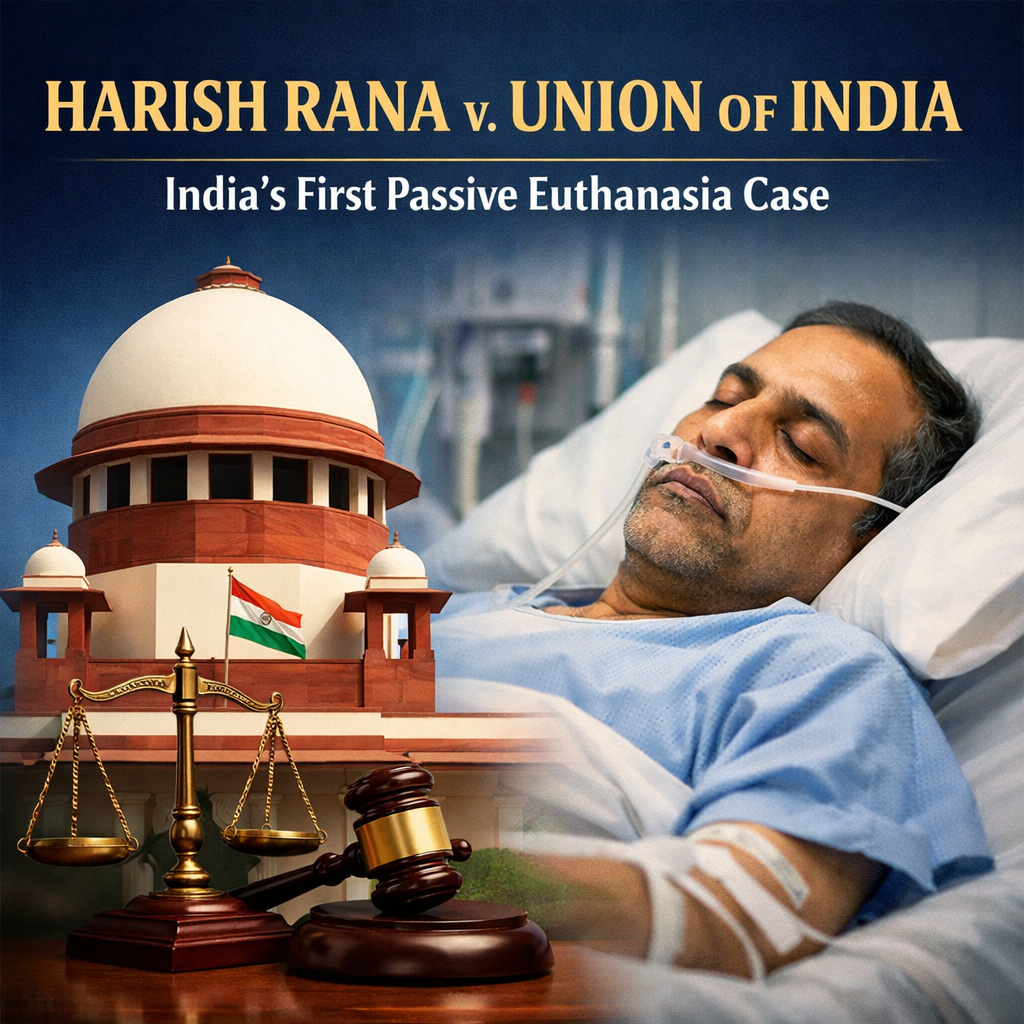
Harish Rana v. Union of India

This Article is written by Disha Hirwani, she is a 2nd-semester LL.B. student at Aishwarya College of Education and Law. She also serves as an author at Lexful Legal.
The Supreme Court of India delivered a landmark judgement which shows that Justice J. B. Pardiwala experienced emotional distress as he delivered his historic judgement of his life that permits passive euthanasia for a 32-year-old man who has been in a vegetative state for 13 years.
Bench –
Justice J. B. Pardiwala
Justice K. V. Vishwanathan
Court – Supreme Court of India
Jurisdiction – Miscellaneous Application
Facts of the Case
- A young engineering student at Punjab University named Harish Rana suffered a critical head injury from a fourth-floor building fall, which occurred in 2013. The accident gave him severe brain injuries that resulted in him being permanently vegetative. He existed in a state of biological life, but he lacked all forms of awareness and consciousness.
- The doctors check his medical condition, and they say that he will never regain his ability to wake up. He remained in this state for 13 years. His body relied on a feeding tube as the only method to receive essential nutrients and fluids, which kept him alive.
- His parents showed their unending devotion through their nursing duties throughout this extended period. The parents eventually reached the heartbreaking conclusion that their son would never recover from his condition, which meant that medical treatment would only extend his life without any chance of improvement.
- The parents filed a case with the Supreme Court to end their son’s life support because they believed artificial life support would not bring him any medical benefits.
Legal Issues in Front of the Court
- Whether withdrawal of such treatment would amount to passive euthanasia.
- Whether allowing withdrawal of the life support system violates the Right to Life under Article 21 of the Constitution.
- What standards should guide courts in determining the best interests of an incapacitated patient.
Petitioners’ Arguments:
The parents showed that the artificial life support system, which their son required, could not heal his medical condition because it only extended his temporary biological life. According to them, the feeding tube and other medical support were merely keeping his body alive without any chance of recovery or improvement.
The doctors who assessed Harish confirmed that he had reached a state from which there existed no medical possibility of treatment or recovery. The doctors confirmed that his brain damage was permanent and that he would never regain consciousness.
The parents presented their argument that forcing someone to remain alive in such a state constitutes a violation of the patient’s dignity. The parents believed that their son should receive relief from his extended period of unnecessary and pointless suffering.
The couple requested the court to allow them to discontinue their son’s artificial life support system. They wanted their son to experience a natural and peaceful death, which would allow him to maintain his dignity.
Respondent’s Argument
- The Union of India argued that decisions related to the withdrawal of life support systems must be taken with extreme caution because such decisions directly affect a person’s life. The government established that unrestricted withdrawal of life support systems results in two harmful outcomes: misuse and wrongful decision-making.
- The statement established that before any such actions could proceed, the organization needed to follow strict procedural safeguards. The government needs both established guidelines and precise checking methods to determine whether the decision meets ethical standards and legal requirements while proving itself to be necessary.
- The Union of India, therefore, requested the court to ensure that proper medical procedures are followed. A competent medical board needs to re-examine the patient’s condition because it must provide an expert opinion. The decision-making process to withdraw life support requires this assessment to demonstrate that it serves the patient’s actual needs.
Judgment
The Court examined all the medical experts’ reports and constitutional principles. The medical procedure can be stopped under specific circumstances, which include cases where recovery becomes medically unattainable.
The Court confirmed that Article 21 Right to Life and Liberty includes the right to die with dignity when life-support systems provide no relief.
The process of withdrawal needs to follow established safeguards while doctors assess the situation to prevent any potential abuse.
The Court used previous rulings, which included Aruna Shanbaug v. Union of India, as its foundation for the judiciary system.
Medical Ethics
- It plays a crucial role, especially in cases of irreversible medical conditions.
- In modern times, it is possible to prolong biological existence through feeding tubes, ventilators, and other life-support systems.
- Medical ethics generally follow four principles:
Autonomy
Beneficence
Non-maleficence
Justice
- These principles focus on the best interests of the patient and aim to avoid unnecessary harm.
- In cases such as a permanent vegetative state, treatment may only continue biological existence.
- Medical ethics, therefore, recognize that allowing a natural death in such conditions may be in the best interest of the patient, rather than. han forcibly prolonging biological life.
Right to Die with Dignity
The judicial interpretation of Article 21 provides its meaning through its official definition. The P. Rathinam v. Union of India
The case established that Article 21 protects the right to die, which makes Section 309 of the IPC unconstitutional, according to the Court.
The Supreme Court of India
Gian Kaur v. State of Punjab
The case overturned the previous decision, which declared that Article 21 does not include the right to die. The Court explained that people who wish to die with dignity at the end of their life have rights under Article 21.
Aruna Shanbaug v. Union of India
The Supreme Court permitted passive euthanasia under strict supervision.
Common Cause v. Union of India
The Supreme Court recognized that life should be lived with dignity and individuals have the right not to prolong life artificially when it no longer serves their dignity.
Role of Families in End-of-Life Decisions
- When patients reach an irreversible vegetative state, their families become the primary decision-making authority.
- The family members of the patient possess complete knowledge about their loved one’s best interests and their personal wishes and values. However, family decisions are not absolute.
- Such decisions must be supported by medical evidence.
Legal Safeguards
The law includes multiple safeguards
- That help prevent misuse of its provisions according to its established framework.
- The medical condition must be verified by independent medical experts.
- The doctors have to establish that the medical condition of the patient will not improve.
- The hospitals need to operate according to established legal requirements and medical standards.
- The decision requires judicial oversight because it needs to be confirmed as lawful.
- The safeguards protect vulnerable patients while end-of-life decisions undergo a process of ethical and legal evaluation.
