Difference Between Insolvency & Bankruptcy

This Case Analysis is written by Hitesh Bhootra, he is a 3rd-year LL.B. student at Aishwarya College of Education and Law. He also serves as an author at Lexful Legal.
The legal term insolvency refers to a situation where a person or business cannot meet their financial obligations, while bankruptcy serves as a formal legal declaration of permanent insolvency. The two concepts require proper understanding because they deliver different results for people and businesses, and their legal agents and government officials who deal with financial problems. The Insolvency and Bankruptcy Code 2016 is a uniform legislation that prescribes the procedure to be adopted for both insolvency and bankruptcy in India, even as each such process will have different rules and requirements.
INSOLVENCY: A FLOW OF FINANCIAL CONDITION
Insolvency refers to a situation when a person or organisation loses the capacity or ability to pay due debts. The concept is not a legal declaration because it describes an actual situation where a person or organisation is experiencing financial constraint due to inadequate cash flow and whose total assets have become less than their total financial obligations. Under the concept, there are two kinds of insolvency, namely cash-flow insolvency and balance-sheet insolvency.
A debtor has cash-flow insolvency when they do not have sufficient liquid assets to meet current liabilities, although the debtor’s assets may be highly valuable. A business with high inventory and fixed asset production capacity may face insolvency because it cannot convert its assets into cash fast enough to pay its creditors. Balance-sheet insolvency occurs when a debtor has total debts that surpass their total assets, which results in negative net worth. The financial system of the entity experiences a more serious issue through this problem.
The process of insolvency does not bring about any instant legal results that need to occur. Creditors and an insolvent company need to work together to handle their debt problems while they also seek to make their business operations better until they achieve financial stability. Organizations often use accounting metrics to determine their financial status which shows their current state of insolvency through three specific indicators: their total losses have reached a point which destroys their capital base, their debt-to-asset ratios have become worse, and their cash balance now stands at zero. The enterprise is considered to be in “insolvency” until the enterprise arrives at its final financial situation.
Bankruptcy is a “Legal determination”
Bankruptcy is a judicial final judgment made through a court of law which determines the person or organization is unable to pay their debts or obligations. The legal procedure establishes a path that leads to the official recognition of insolvency through judicial evaluation. The IBC 2016 defines bankruptcy under Section 79(3) as follows: a debtor adjudged bankrupt by bankruptcy order under Section 126; each partner of a firm against which a bankruptcy order has been made; or any person adjudged an undischarged insolvent.
The judicial system maintains total control over the bankruptcy process which follows the rules established by existing laws. The legal system considers bankruptcy as a financial problem which arises from official judicial proceedings that begin in authorized courts such as the Debt Recovery Tribunal for individuals and partnership firms and the National Company Law Tribunal (NCLT) for corporate companies . The bankruptcy process creates two distinct effects which give both protection and penalties to the debtors . It establishes a credit freeze during which creditors cannot take legal action against the debtor while their assets undergo controlled liquidation and the debtor can achieve complete debt relief after finishing the required legal process.
Key Distinctions
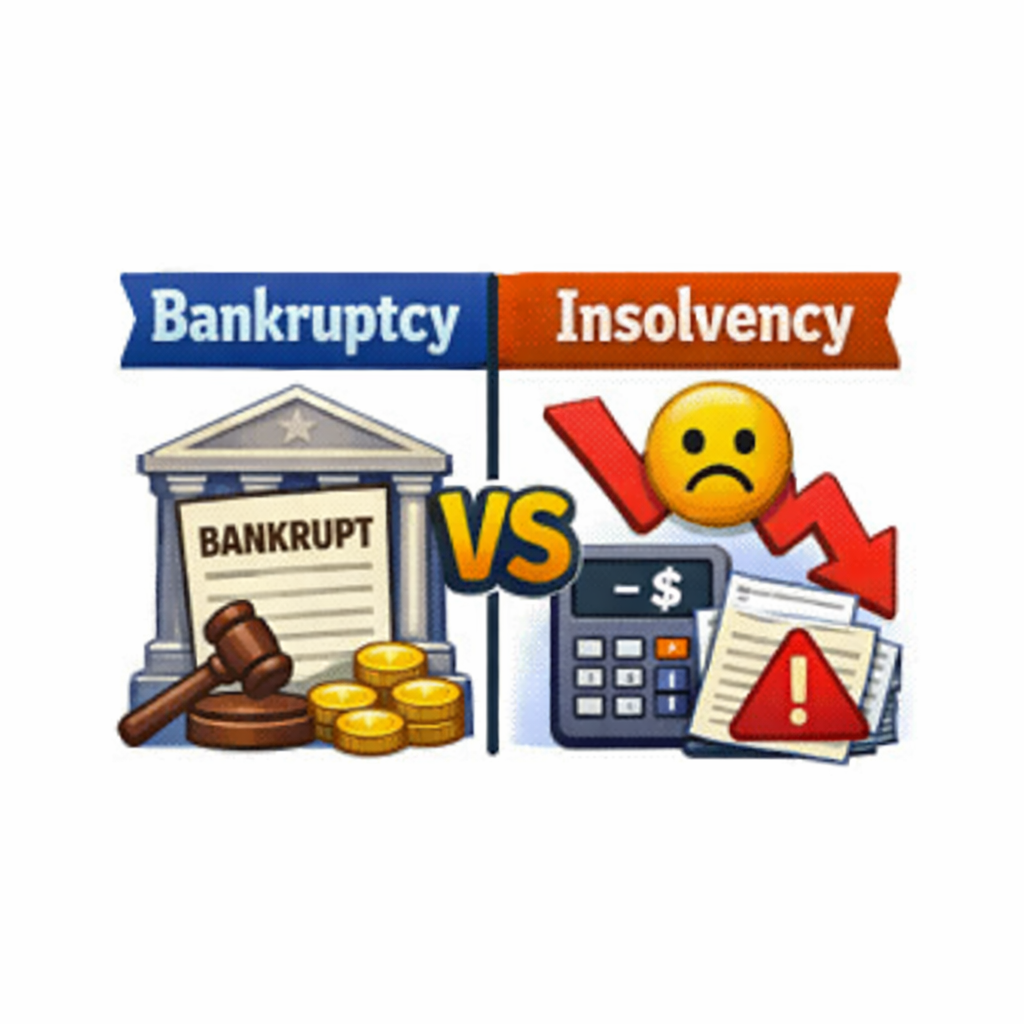
Nature and Character: The state of insolvency exists as an economic situation which shows a person or business fails to meet their financial obligations. The legal status of bankruptcy exists as a formal determination which results from judicial or administrative proceedings. The distinction between these two elements extends beyond mere word differences because it determines how debtors will manage their rights and duties while accessing their legal remedies.
Initiation and Procedures: The process of insolvency which can be develop through natural means without any need for legal intervention. A debtor can also recognize insolvency through financial analysis and seek resolution through private negotiation, debt restructuring, or voluntary settlement arrangements by them. The process of bankruptcy requires businesses to submit their cases to an official decision-making body which leads to the bankruptcy ruling. The IBC allows creditors to submit bankruptcy applications against individuals through individual or group applications or through the debtor’s own application after all methods for resolving insolvency have been attempted and failed.
Temporal Sequence: The process of insolvency typically happens before bankruptcy follows in both logical order and time sequence. Bankruptcy requires that a person first goes through a period of insolvency which then leads to the bankruptcy process. Many insolvent entities successfully restructure through resolution processes and avoid the bankruptcy determination. The principle received demonstration through the case of Essar Steel India Ltd. v. Satish Kumar Gupta (2020) which showed how the corporate debtor used a structured resolution plan to solve its financial crisis instead of declaring bankruptcy after it reached a point of severe insolvency with total liabilities of INR 49,000 crore. The Supreme Court approved ArcelorMittal’s resolution plan which showed how creditors used their business knowledge to resolve insolvency matters without entering the bankruptcy process.
Insolvency which results from short-term cash-flow problems can become reversible through operational improvements and refinancing solutions and creditor payment deferrals. The organization which faces temporary cash deficits and normal business interruptions will regain its financial stability after implementing its planned solutions. A formal legal proceeding establishes bankruptcy status which endures until the bankruptcy order receives official cancellation and discharge while the process affects both the debtor’s future credit record and business operations abilities.
Scope of Application: The IBC statutory framework establishes two separate legal systems which create a major legal distinction. The system enables companies to resolve their insolvency through judicial procedures while their assets undergo liquidation but it does not use the term “bankruptcy.” The IBC Part III of the Indian Bankruptcy Act applies to individual and partnership bankruptcy cases. Two methods are available for corporate financial issues and limited responsibility partnerships: corporate Insolvency resolution systems and liquidation processes.
The Indian Legal Framework: IBC, 2016, and Constitutional Safeguards
The Indian Legislation (IBC) , 2016 provides consolidates all previous laws which dealt with Financial Hardship Cases from before the law’s enactment. The IBC 2016 requires a Corporate Insolvency Resolution Process with a maximum time limit of 330 days. This represents a deliberate policy choice to expedite resolution and enhance creditor recovery which fundamentally transformed the Indian restructuring landscape since its enactment.
The Supreme Court confirmed IBC constitutional validity through its decision in Swiss Ribbons Pvt. Ltd. v. Union of India (2019) because the court dismissed all Article 14 Constitution-based challenges. The petitioners argued that financial creditors and operational creditors received different treatment according to their rights to equal treatment. The Supreme Court determined that the classification system contained both intelligible differentia and rational links to the legislative goal of increasing asset value through entrepreneurial development. The Court explained that financial creditors participate in determining business viability while operational creditors only handle limited financial information. The ruling established definite legal standards which enhanced IBC system trust among investors.
Part II of the IBC establishes insolvency resolution methods for corporate debtors which enable the Committee of Creditors to choose between two options, either deciding to restructure the debtor’s obligations through a resolution plan or proceeding with liquidation after resolution attempts fail. The appointment of an Interim Resolution Professional takes place right after the court admits the insolvency application, and creditor enforcement actions stop during the resolution period because of the moratorium rules.
The Code establishes an insolvency resolution method through fresh start and earned discharge for individuals and partnership firms who fall under Part III. The Section 126 process which begins with these procedures, must fail before anyone can ask for a bankruptcy order which results in formal bankruptcy adjudication and bankruptcy trustee management of the debtor’s assets.
Conclusion
The legal system handles insolvency and bankruptcy as two distinct processes because both terms share a common relationship. The financial state of insolvency occurs when a person or business cannot pay their debts but it can be solved through debt restructuring or debt negotiation. The legal system establishes bankruptcy as a binding status which judges use to decide cases when a person or business continues to be insolvent. The Insolvency and Bankruptcy Code 2016 establishes a complete system which resolves both issues through a time-based process that prioritizes debt resolution while protecting the rights of creditors and debtors. The distinction between these two concepts must be understood clearly because it impacts three areas: legal practice, economic stability, and fin
